
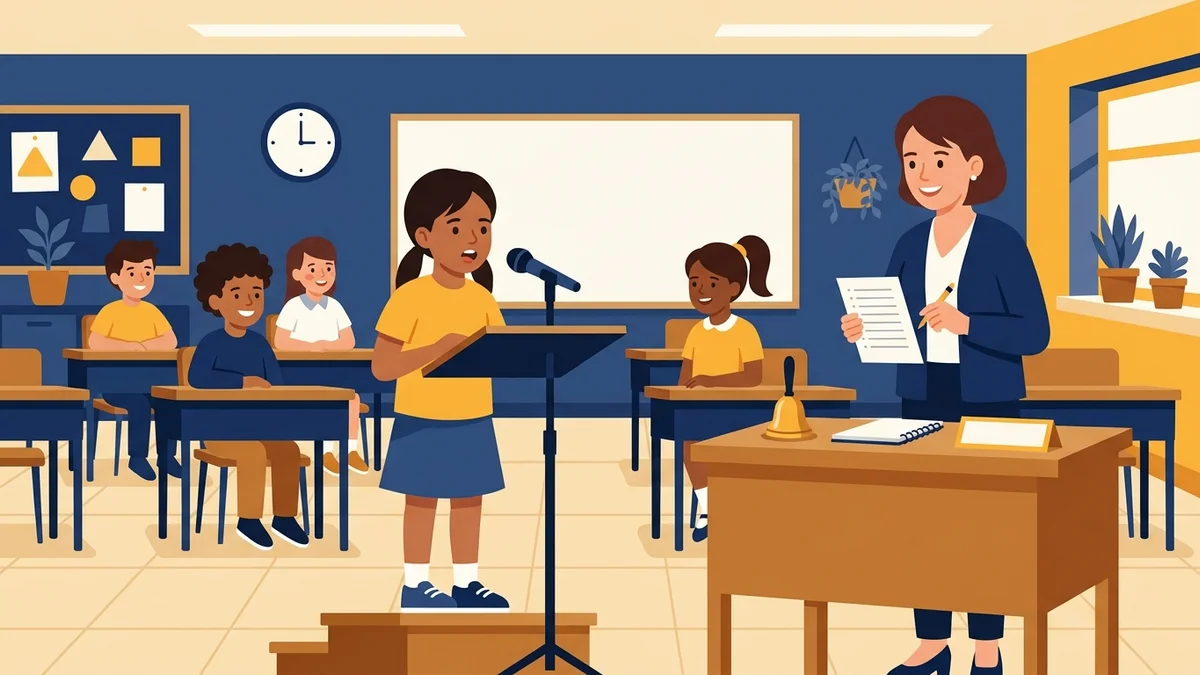
To run a classroom spelling bee, pick a word list, line up three helpers (a pronouncer, a judge and a record keeper), give every student a number, and spell in rounds: a correct speller stays in, a misspelling is out, and the last speller standing wins. This guide walks through each step, including the official Scripps resources, the rules students ask about most, and how to handle ties.
Editorial Note: Spelling Bee Hub is an independent fan site. We are not affiliated with the Scripps National Spelling Bee, E.W. Scripps or The New York Times. This guide is about running an in-person (or virtual) school bee, not the NYT Spelling Bee puzzle game.
Classroom bee, school bee, Scripps bee: what's the difference?
Most school bees follow a ladder. The Scripps National Spelling Bee describes it as a classroom bee first, then a school bee, then regional bees, then the national competition in May. Classroom bees are the widest net: every student can try, and the winner moves up.
You don't have to join the Scripps program to run a bee in your own room. You do need it if you want your champion to advance toward a regional bee. Here is what the Bee says about enrolling for 2026-27, as of October 10, 2026:
| Question | Answer from spellingbee.com |
|---|---|
| Who enrolls? | Educators enroll elementary and middle schools. Restrictions apply in some areas. |
| When? | August 18, 2026 through January 29, 2027 (earlier in some areas) |
| Cost | $199 per school through November 30, 2026; $225 per school from December 1, 2026 |
| What you get | Official study lists by grade, the 4,000-word Words of the Champions, competition lists, written test materials, how-to guides, certificates |
| Where classroom bees happen | "Throughout the fall," using the Bee's resources |
If your school is already enrolled, ask your School Bee Coordinator for the educator-portal login. If you're not enrolled, use the "without enrollment" option in Step 2.
Step 1: Decide what kind of bee you want
Ask one question first: should the winner advance?
- Yes, on the Scripps path. Enroll the school, use the official Classroom Competition List and follow the Bee's suggested rules. The Bee says local officials may adapt them, so your regional partner's rules win if they differ.
- No, just a fun class event. Use any grade-appropriate list, keep the rules simple, and give every child a certificate.
Either way, tell families which kind it is before the bee, so no one expects a regional trip from a fun round.
Step 2: Choose your word list
Words are where most bees succeed or stall.
With enrollment: use the Classroom Competition List from the educator portal. According to the Bee's Spelling Bee 101 guide (2024 edition), a classroom list begins with 225 words from the School Spelling Bee Study List and ends with additional words that students haven't studied, saved for the last rounds. The size of that extra section changes by year: the 2024 guide says 25 words, while the Bee's 2026 competition list describes 75 (words 226 to 300). The 2027 lists reach enrolled schools from August 18, 2026, so count the extra words on your own list. Students study 50 words at their own grade level, sorted into One Bee, Two Bee and Three Bee.
Without enrollment: build a list from a grade-level source. Our spelling bee words by grade guide has sample words for grades 1 through 8, and the Scripps word lists page has harder words sorted by language of origin. Those are our own selections, not the official competition lists, so tell students that. For the official 2027 study books, read Words of the Champions 2027.
Whichever list you use:
- Print it, with a clean copy for each official.
- Check every definition, part of speech and sentence before the day.
- Mark words with homonyms (to, too, two) so the pronouncer always gives the definition.
- Cut anything unkind, crude or off-topic for your class.
Step 3: Line up your three officials
The Bee separates officials (who run the contest) from organizers (who run the event). For a classroom, you can fill all of them yourself with a few helpers.
| Role | What they do |
|---|---|
| Pronouncer | Says each word and gives the definition, sentence, part of speech, language of origin or alternate pronunciation if the speller asks |
| Head judge | Rules on spellings, answers questions about the rules, and rings a bell or says "that is incorrect" |
| Record keeper | Writes down each speller's letters and tracks rounds and who is still in |
At classroom and school bees, the Bee says one judge, the head judge, usually suffices. A phone recording of each turn helps if someone disputes a spelling.
Pick officials carefully. The Bee advises against recruiting relatives of current spellers, or anyone coaching a speller, to avoid conflicts of interest. For the pronouncer, an English or classics teacher, a librarian or a former speller from your high school works well. Classroom-level words are usually familiar enough that diacritical markings aren't a big barrier.
Materials checklist: word lists, a bell (or a free bell-sound app), a speller roster, paper and pens for officials, name placards or number cards, a microphone if the room is large, and certificates.
Step 4: Announce the rules before round one
Read these aloud, and print them for parents. They follow the Scripps Suggested Rules, which local bees may change:
- Numbered order. Give each student a number so the order stays the same every round.
- Ask for help. A speller may ask for the definition, part of speech, language of origin, a sentence or an alternate pronunciation, as listed in the competition list. Slower pronunciations, other definitions and root-word questions aren't allowed.
- Restarting is fine, changing isn't. A speller may start over, but cannot change the letters or order already said.
- Letters only. You don't need to say capital, hyphen, space or accent marks. Judges listen for the right letters in the right order.
- Wrong is out. If the spelling is incorrect, the student is out. Spell the word correctly for them and thank them, which turns the miss into a lesson.
- One dictionary. If you use the Bee's lists, spellings follow Merriam-Webster Unabridged, the Bee's official dictionary. Don't accept a spelling that only appears in another dictionary.
- Homonyms. If the speller spells a different word with the same sound and was not given the definition, reinstate them.
Decide your appeals rule ahead of time; the Bee leaves it to each bee.
Step 5: Run the rounds
Here is a simple script you can adapt for the day:
- Welcome. Introduce officials, read the rules and explain what happens to eliminated spellers.
- Round 1. Call speller 1. The pronouncer says the word. The speller says the word, spells it, then says it again. (The Bee encourages this but doesn't require it.)
- Ruling. The head judge confirms or rings the bell. The record keeper marks it.
- Continue through every remaining speller in number order. Then start the next round at speller 1.
- Pace the list. Between rounds, glance at the results. If almost everyone is spelling correctly, jump ahead 25 or 50 words, never in the middle of a round. Make sure you have at least as many words left in a section as you have spellers.
- Warn before the last words. Before you reach the unstudied "additional words," announce it, so students and parents know the list changes there.
As a rough planning estimate (our own rule of thumb, not an official or sourced figure), allow 45 to 60 minutes for 10 to 15 spellers, plus setup. Speed depends on grade level and pronouncer. The Bee says an ideal bee has 20 to 40 spellers. If more qualify, give a short written test first and take the top scorers.
Step 6: Break ties and crown a champion
The Bee's Spelling Bee 101 guide gives clear rules for the end:
- If everyone misses in the same round, reinstate everyone who spelled in that round and start a new round in the original order.
- If one speller is left, give them the next word on the list. If they get it right, they're champion. If they miss, reinstate the spellers who missed in the previous round and play on.
- If you run out of time or words, consider a short written tiebreaker. The Bee offers an Online Testing Platform for classroom and school tests, and recommends running spelling bees in person when possible.
Local officials can adapt end-of-bee procedures. Whatever you decide, say it before the bee starts.
Make it work in a real classroom
Practical tips that save the day:
- Keep eliminated students involved. Let them be audience judges, timekeepers or "word wranglers" who hold the next card. The goal is love of words.
- Plan accommodations in advance. The Bee's rules say officials have discretion to change oral or written requirements case by case. Ask families early.
- Use a visible scoreboard. Cross off names on a slide or chart so everyone sees who's left.
- Celebrate everyone. Print certificates for every speller, not just the champion.
For practice before the day, send students to our Spelling Bee preparation guide, and try a no-pressure warm-up with a homemade Spelling Bee puzzle.
Timeline: when to do what
| When | What to do |
|---|---|
| Now to mid-November | Enroll (if you want the Scripps path) and pick a bee date |
| Two weeks before | Send students their study lists and tell families the rules |
| One week before | Recruit officials, print lists, test the microphone |
| Bee day | Run the bee, announce the champion |
Common mistakes
- Springing new rules on the day. Announce every rule up front.
- Using the wrong list level. Classroom words should feel familiar, not like a regional final.
- Skipping the pronouncer's prep. A mispronounced word is the fastest way to a dispute.
- Moving the list mid-round. Jump only between rounds.
Ready for the bee?
When practice is over, the Scripps word lists page and our words by grade guide give you extra material for practice rounds. And if your class also likes the daily online puzzle, today's Spelling Bee answers are on our homepage for after school.
Frequently Asked Questions
Do I need to enroll with Scripps to run a classroom spelling bee?
No. You can run a bee in your own room with any grade-level list. Enrolling gives you the official competition lists, guides and certificates, and it's the way your champion can move up to a regional bee. Enrollment for 2026-27 is open through January 29, 2027 (earlier in some areas).
How many words do I need for a classroom bee?
It depends on how many spellers you have and how well they know the words. The Bee's classroom list begins with 225 studied words and ends with a set of additional words (25 in the 2024 guide, 75 in the 2026 list), so check the count on your own list. If you aren't using it, plan at least as many words as spellers for every round, plus extras for the end.
How many judges and officials do I need?
Three roles: a pronouncer, a head judge and a record keeper. At classroom and school bees, the Bee says one judge usually suffices. Avoid relatives of spellers as officials.
Can a student ask for a sentence or the origin of a word?
Yes. Under the Bee's suggested rules, a speller can ask for the definition, part of speech, language of origin, a sentence or an alternate pronunciation. Requests for slower pronunciation, other definitions or root-word questions aren't allowed.
What if every speller misses a word in the same round?
Reinstate everyone who competed in that round and start the next round in the original order, as the Bee's guide recommends.
Can a student start over while spelling a word?
Yes, but the letters and order already said can't change. If a student says "C-H-Y, can I start again?" and then spells it correctly, the first attempt still counts, so they're out.