
Every Spelling Bee puzzle has at least one pangram — a word that uses all seven hive letters. But some days deliver something rarer: a perfect pangram that uses each letter exactly once. Spotting one feels like finding a golden ticket in the honeycomb.
1. Regular Pangrams vs. Perfect Pangrams
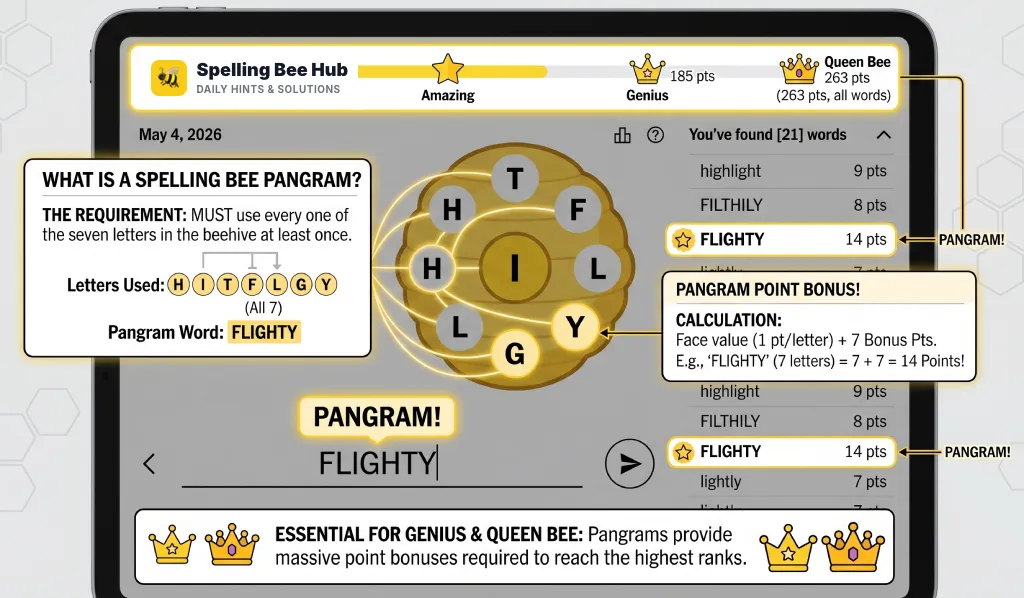
A standard spelling bee pangram is any valid word that includes all seven letters from the hive at least once. The center letter must appear, and every outer letter must show up somewhere in the word. Most pangrams are longer than seven letters, so some letters repeat.
A perfect pangram is a seven-letter word where each hive letter appears exactly once — no repeats, no extras. They are far less common because the letter set has to align perfectly with a real English word. When one exists in a puzzle, players often celebrate it as the cleanest possible pangram find.
Not every puzzle has a perfect pangram. Some letter combinations simply do not form a valid seven-letter word in the Spelling Bee dictionary. That is part of what makes them special when they do appear. Browse our pangram archive to see how often different hive shapes produce them.
Pro Tip: Check the Glossary First
If you are unsure whether a word qualifies, our Spelling Bee glossary defines pangram, perfect pangram, bingo, and other hive terms so you know exactly what you are hunting for.
2. How Pangrams Affect Your Score
Pangrams carry a flat 7-point bonus on top of the word's base score. A four-letter pangram is worth 8 points total (1 + 7). A seven-letter perfect pangram earns 14 points (7 for length + 7 for the pangram bonus). That single find can jump you several ranks in one submission.
Because the bonus is fixed at 7 points regardless of word length, shorter pangrams give you more bang for your buck relative to the letters you type. A perfect pangram at seven letters is efficient scoring — you get the full length value plus the bonus without wasting time on longer variants.
On tough days when Genius feels out of reach, finding any pangram early often unlocks enough momentum to keep going. Use our genius calculator to see exactly how much a pangram moves you toward the ~70% threshold.
3. How to Spot a Perfect Pangram
Start by scanning for seven-letter words once you have exhausted the obvious four- and five-letter finds. Mentally tick off each outer letter as you build the word — if you reach seven letters and every hive letter has been used exactly once, you may have a perfect pangram.
Letter frequency in the hive matters. Puzzles with balanced vowel-consonant mixes tend to produce more pangram candidates. When the center letter is a common vowel like E or A, longer pangrams appear more often, but perfect pangrams still depend on the outer six letters forming a valid word.
Anagram practice helps. Shuffle the seven letters in your head or on paper and look for recognizable fragments. Words ending in common suffixes like -ED or -ING rarely work as perfect pangrams because they require extra letters beyond the seven available.
Pro Tip: Learn the Repeat Offenders
Certain pangrams show up again and again across different hives. Our breakdown of the top Spelling Bee pangrams highlights the words that Sam Ezersky's puzzles favor, so you recognize them faster when the letters align.
4. When to Hunt vs. When to Move On
Chasing a perfect pangram can eat up valuable time if the letter set does not support one. If you have been cycling through anagrams for ten minutes with no luck, the puzzle may only offer standard pangrams — and that is fine. A 9- or 10-letter pangram still delivers the same 7-point bonus.
Prioritize the pangram hunt after you have cleared easy words and built a solid point base. Early Genius pushes are better served by volume (lots of 4- and 5-letter words) than by fixating on a seven-letter unicorn. Save deep pangram searching for when you are within striking distance of your target rank.
Conclusion: The Crown Jewel of the Hive
Perfect pangrams are the rarest, most satisfying discovery in the NYT Spelling Bee. They do not appear every day, but understanding the difference between regular and perfect pangrams — and how the scoring bonus works — makes you a sharper, more efficient player. Keep an eye on the seven-letter possibilities, and when the hive cooperates, enjoy the sweetest find in the game. Not every pangram is perfect, and some are just strange: see our round-up of odd pangrams.