
Most mornings we open the hive the same way you do: a little too confident, then stuck on a stubborn prefix. This guide is how we use spelling bee nyt hints, a free spelling bee for extra practice, and the rest of our tools without wrecking the fun of finding the words ourselves.
Spelling Bee Hub is unofficial fan help. We are not affiliated with the New York Times, NYT Games, or the editors who choose each day’s letters. If you play the official puzzle, treat this site as a companion: live tools that update with the hive, plus a place to practice when you want another round. This article will not dump today’s answers. Letters change every day, and publishing a spoiler list here would go stale by tomorrow and ruin the hunt for anyone who landed on a guide instead of a solver.
What we can do is explain the difference between a nudge and a giveaway, how our homepage relates to the official game, and which page to open when you only want spelling bee help that still lets you do the work.
Spelling Bee NYT Hints: Get Unstuck Without the Full List
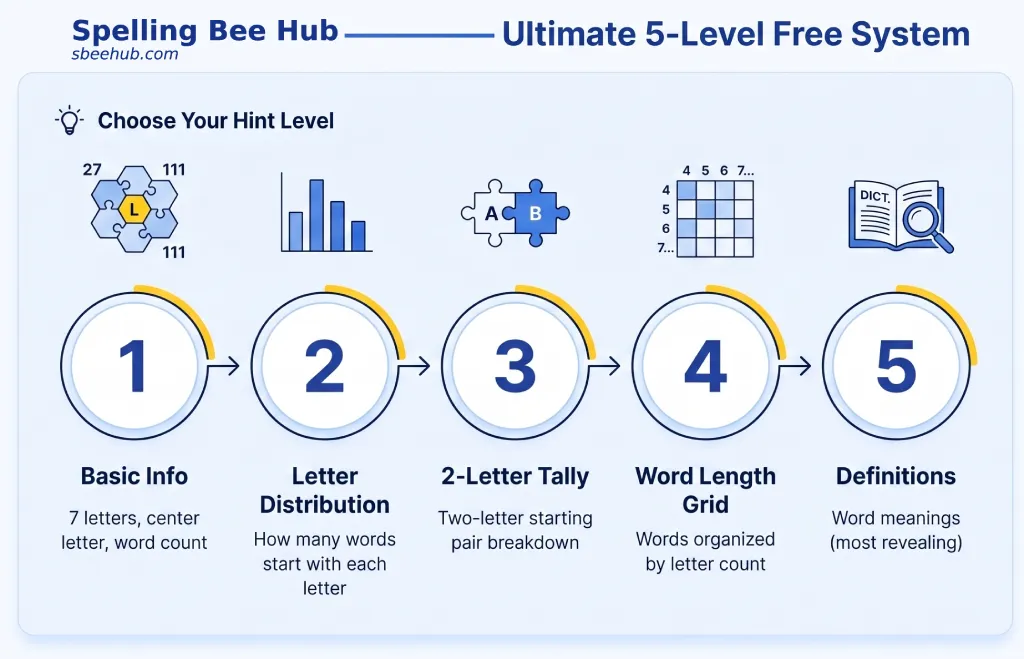
When people search spelling bee nyt hints, they usually want a middle path. They have already found the obvious four-letter words. They can feel a longer word sitting just out of reach. They do not want a wall of solutions yet. That is exactly the job of our hints page.
The useful spelling bee nyt hints are structural, not lexical. A two-letter tally tells you how many valid words start with each pair. If CO shows a high count and you only have coffee in your notebook, you know the hive is richer than your list. A total word count tells you whether you are looking at a sparse morning or a packed one. A pangram count tells you whether there is one “use every letter” word or more than one. None of those facts spell the word for you. They just point your attention.
We use spelling bee nyt hints after we have already played. Fifteen or twenty minutes of honest searching is enough to fill the easy ranks. Then we glance at the grid and hunt the pairs we ignored. That order matters. If you open hints first, every later find feels a little hollow. If you open them after you have a personal list, the grid becomes a checklist of gaps instead of a spoiler.
Good spelling bee nyt hints also have an off switch. You can look at starting letters and still refuse to look at the answer column. You can check whether a pangram exists without revealing it. You can compare your score to Genius without asking for the remaining words. The genius calculator is part of that same idea: it tells you how much runway is left, not which words fill it.
If a hint still is not enough, escalate slowly. Look at one high-count pair. Try common suffixes on that pair. Only then consider the pangram page or the full list. The point of spelling bee nyt hints is not to finish faster. It is to finish with more of the work still yours.
Spelling Bee NYT: The Daily Hive, Not a Random Word List
Spelling bee nyt is shorthand for the daily seven-letter puzzle most of us mean when we say “the Bee.” One center letter is required in every word. The six surrounding letters are optional. Words are at least four letters. Proper nouns, hyphenates, and most abbreviations stay out. You score by length, with a bonus when a word uses every hive letter.
That spelling bee nyt format is why the same habits work day after day. You learn to test prefixes. You learn which suffixes love a given center. You learn that a hive with S will hide a lot of plurals, and a hive without S will feel meaner. You also learn the emotional shape of a morning: Amazing comes fast, Genius takes a second wind, Queen Bee is a scavenger hunt.
Our live tools follow that spelling bee nyt hive. The homepage is built around today’s letters. The archive stores previous days so you can study patterns without mixing them into the current puzzle. If you want yesterday’s pangram or a brutal center from last month, the archive is the right shelf. If you want this morning’s puzzle, stay on the live pages and ignore the rest.
One honest caveat about spelling bee nyt as a search phrase: people use it for both the official game and for fan sites like ours. We try to be clear about which is which. The New York Times publishes the puzzle. We publish unofficial help around it. If your streak lives on NYT Games, play there. Use us when you want a second screen, a different hint style, or a way to practice without spending today’s hive.
Another practical note: spelling bee nyt resets on a daily clock, not when you personally finish. If you come back at lunch, the letters are the same. If you come back after the reset, they are not. That is why this blog post stays evergreen. We would rather teach you where the live tools live than paste a word list that expires overnight.
NYT Spelling Bee: Official Play vs. Fan Tools
NYT spelling bee is the official daily product: the hive, the ranks, the streak, the editor’s word list. It is a designed experience, not just a dictionary dump. Some words you can form from the letters will still be rejected because they are too obscure, too slangy, or simply not on the list. That editorial layer is part of why the puzzle feels fair even when it is hard.
When we talk about nyt spelling bee on this site, we mean that daily official-style hive and the help we build around it. We do not claim to be the game. We do not sell NYT access. We do not promise that every word our solver returns would be accepted in the official app. For the live day, our answers and hints are aligned to that hive. For custom letter sets, the spelling bee solver is a practice engine: feed it seven letters and a center, and study the shapes that appear.
That distinction matters for anyone who wants nyt spelling bee to stay a ritual. If you dump the official puzzle into a solver at 7 a.m., you get a complete list and a hollow breakfast. If you save the solver for made-up hives or archive days, you can train prefixes without touching today’s streak. We play it that way ourselves. The official nyt spelling bee is the performance. Everything else is rehearsal.
Pangrams sit in the middle of that ritual. Finding the word that uses every letter is often the difference between a decent score and Genius. Our pangrams page is there for days when you want that specific reveal and nothing else. It is still a spoiler, just a narrower one. Many of us would rather see the pangram than the entire list, because the rest of the hive still has work in it.
If you are new to nyt spelling bee, ignore Queen Bee for a month. Learn the ranks. Learn which four-letter words are “cheap points” and which seven-letter words are worth hunting. Read the two-letter grid as a map, not a test. The game rewards pattern memory more than trivia. That is also why a companion site can help without replacing the official board: the skill transfers, the spoilers do not have to.
Free Spelling Bee: Practice Without Spending Today’s Hive
A free spelling bee is useful when you want the mechanic without the once-a-day pressure. Maybe you already finished the official puzzle. Maybe you are teaching a kid the rules. Maybe you do not subscribe to NYT Games and still want a hive. Our free spelling bee game is built for that. It is practice, not a pirate copy of every NYT feature.
We are honest about the trade. A free spelling bee on a fan site will not give you an official streak, editor notes, or the exact social layer of NYT Games. What it can give you is unlimited reps. You can try a letter set, fail, try another, and start to see why some centers are brutal. You can also use the solver as a free spelling bee lab: type a hive, hide the answers, play on paper, then check.
That is the clean split we recommend. Official nyt spelling bee: one hive, your real score, no peeking until you choose to. Free spelling bee: extra boards, teaching boards, “what if the center were R” boards. Mixing those modes is how people either get better or get bored. If every session is a spoiler, you stop noticing prefixes. If every session is unsponsored struggle with no feedback, you quit. Hints and a free spelling bee exist to sit between those extremes.
Families and classrooms often want a free spelling bee because the official app is a personal streak machine. A projected or shared practice hive lets several people shout words without burning anyone’s daily puzzle. Keep the official letters off the board if someone in the room still wants to play later. Use a custom set from the solver, or an archive day everyone agrees is fair game.
If you only remember one thing from this section: free spelling bee practice is for skill. The daily hive is for the score you care about. Use our game and solver when you want reps. Use the live homepage and hints when you want today’s letters. Do not paste today’s official answers into a group chat and call it a free spelling bee. That is just a spoiler with extra steps.
Spelling Bee Help: Hints vs. Answers, and a Workflow That Stays Fun
Spelling bee help is not one button. It is a ladder. The lowest rung is your own list. The next is a two-letter tally. Then remaining points. Then pangram. Then the full answer list. Most frustration comes from jumping rungs. People search spelling bee help, click the first complete list they see, and feel nothing when Genius pops. The rank still counts. The morning does not.
Here is the spelling bee help workflow we actually use, and that we built the site around:
- Play the official puzzle, or our free game, with no tools for at least a short stretch.
- Open spelling bee nyt hints and scan pairs you underused.
- If you are close to a rank, check the genius calculator so you know whether you need one long word or five small ones.
- If you only want the “use every letter” word, use the pangrams page.
- If you are done hunting, open the homepage answers and study what you missed instead of cringing at it.
That last step is still spelling bee help, just a different kind. An answer list is a study guide after you have finished, not a cheat sheet during the hunt. Look at the words you missed and ask why. Were they -ING forms? Were they starting with a pair you never tried? Did the pangram use a letter you treated as decoration? The archive makes that review possible on days other than today, which is often calmer.
Custom spelling bee help belongs on the solver. If a friend sends a screenshot of seven letters, or you want to rebuild a hive from memory, the solver is the right tool. It is also the right tool when you are not looking for today’s nyt spelling bee at all. Keep those sessions labeled in your head as practice so you do not accidentally spoil the live day.
We get asked whether using any spelling bee help is cheating. There is no referee. There is only the experience you want. If your goal is Queen Bee every day, you will probably peek more often, and that is a valid hobby. If your goal is to get better at seeing words, peek less and review more. If your goal is to share a coffee-break puzzle with a partner, agree on the hint rules before anyone opens a laptop. The tools are neutral. The agreement is the ethic.
A note on spoilers and this page
This article will never list today’s words. If you arrived looking for a paste-ready answer key, go to the live homepage when you are ready, or stay on hints if you are not. We would rather send you to the right tool than hide a spoiler in a blog post that ranks in search for weeks.
How the Rest of the Hub Fits Together
Once you know which spelling bee help you want, the rest of the site is just navigation. The homepage is today’s hive and the complete list. Hints are the spoiler-light grid. Pangrams isolate the all-letter word. The solver is any-hive practice. The game is a free spelling bee you can actually play. The archive is history. The genius calculator is math for the current ranks.
We keep those pages separate on purpose. A single page that shows hints, pangram, and answers at once is convenient for search engines and terrible for humans. If you only wanted the two-letter tally, you should not have to scroll past the pangram. If you wanted the pangram, you should not have to see every four-letter word. That is why spelling bee nyt hints live on their own URL, and why this blog post is a map instead of a dump.
For long-term improvement, mix a little archive study with the daily nyt spelling bee. Notice which suffixes keep showing up. Notice how often a hive hides a chemical, a music term, or a British spelling. You do not need to memorize a dictionary. You need a better instinct for “this letter set wants -ER and -ED more than it wants a nine-letter showpiece.” That instinct is what survives after you close the tab.
If you came from a search for spelling bee nyt and landed here, bookmark three links: hints for the nudge, the free game for extra play, and the homepage for when you are ready to be done. Skip this article next time. It will still be here when you want the rules of engagement, not the letters of the day.
Conclusion: Help That Leaves You Some Work
The best spelling bee nyt hints are the ones you can close. The best free spelling bee is the one that does not steal today’s official hive. The best spelling bee help is a ladder you climb on purpose. Spelling Bee Hub is unofficial, independent, and built for people who like the hunt more than the paste. Use the live tools for the current puzzle. Use this guide when you need to remember which tool is which.
Play the nyt spelling bee your way. Just decide the way before you click. That one habit is the difference between a site that spoils your morning and a site that saves it.