
A spelling bee solver is only a spoiler if you let it be one. Used with a two-letter list and answers hidden, it is a map. Used as a paste button, it is breakfast ruined. This is how we run ours without dumping today’s words.

Spelling Bee Hub is unofficial fan help. We are not affiliated with the New York Times, NYT Games, or the editors who choose each day’s letters. If you play the official puzzle, treat a spelling bee solver as a companion screen, not a replacement hive. This article will not dump today’s answers. Letters change every day, and a spoiler list in a blog post would go stale overnight and steal the hunt from anyone who wanted a method instead of a cheat sheet.
What we can do is show you the difference between Get Hints and Get All Answers, why the center letter required rule matters, and which live page to open when you only want a nudge. Start on the homepage when you are ready for the full list. Stay on hints or the solver when you are not.
What a Spelling Bee Solver Should Do
A spelling bee solver is a letter engine. You give it seven unique letters and mark one as the center. It searches a word list for strings that use only those letters, include the center, and meet the usual hive rules: at least four letters, no proper nouns, letters reusable. That is the whole job. It is not a daily newspaper, and it is not required to shout every word at you the moment the page loads.
People search spelling bee solver because they are stuck, curious, or teaching someone the mechanic. Those are three different moods. Stuck wants a two-letter list. Curious wants a custom letter set. Teaching wants a board you can reset. If a tool only offers Get All Answers, it only serves the person who is already done hunting. A useful spelling bee solver also offers Get Hints: two-letter hints, word count by length, and a pangram highlighted only if you choose to reveal it.
On Spelling Bee Hub, that split lives in two places. The dedicated spelling bee solver is the engine for any hive, including a custom letter set. The hints page is the same idea pointed at today’s letters, with the answers kept off the screen. Use the engine when you want control. Use hints when you want today’s hive without the list. For a custom letter set, treat results as practice shapes: the official list is curated, and not every anagram would score on NYT Games.
Spelling Bee Solver Today vs a Custom Letter Set
Spelling bee solver today is the search people type when they want this morning’s letters already loaded. That is convenient, and it is also the fastest way to spoil your own streak. If the solver auto-fills the live hive and the default button is Get All Answers, you will see every word before you have had coffee. Change the default in your head before you change the letters on the screen.
Our recommendation is blunt. If you still care about today’s official score, do not run spelling bee solver today in full-answer mode. Open live hints instead. If you already finished, or you want rehearsal, then a spelling bee solver today can be a review tool: look at what you missed, notice which two-letter hints you ignored, and close the tab.
A custom letter set is the healthier habit. Type seven letters that are not today’s. Pick a nasty center on purpose. Hide answers. Play on paper or in our free spelling bee game. Then reveal. You get the same muscle memory without spending the hive you actually care about. The archive is the same idea with real past days: yesterday is fair game once you have agreed it is not “today” anymore.
Families should default to a custom letter set. Projected official letters will burn someone’s streak. Build a practice hive, keep today’s board off the screen, and shout. That is still a spelling bee solver. It is just not spelling bee solver today in the spoiler sense.
Center Letter Required: Why the Hive Is Not a Free Anagram
Every serious spelling bee solver should refuse to run until the center letter required field is filled. That is not a UI quirk. It is the rule that separates this puzzle from an anagram toy. Words that skip the center are invalid, even if they look elegant. If you feed a solver seven letters and forget to mark the center, you will get a list that does not match the official game.
Center letter required also changes how you hunt. A center of R wants prefixes and suffixes that like R. A center of Y is a different personality. A spelling bee solver that highlights the center in the honeycomb is doing you a favor: it keeps your eyes on the constraint. When you practice with a custom letter set, move the center around the same six outer letters. The word list will lurch. That lurch is the lesson.
People who skip this rule often blame the spelling bee solver for “missing words” that were never legal. If you are comparing solver output to your official found list, confirm the same center and seven unique letters. Then compare. Read two-letter hints as pairs that still obey center letter required, not as crossword-style across clues.
Get Hints vs Get All Answers
Search pages love the phrase Get Hints vs Get All Answers because that is the fork that matters. Get Hints should mean: two-letter hints, a two-letter list, word count by length, maybe a pangram count, answers masked. Get All Answers should mean: the list, usually with the pangram highlighted, and the hunt over. If a site blurs those buttons, it is not a solver with manners. It is a dump with extra clicks.
On our solver, the same fork shows up as presets: Two-Letter Hints, Minimal Hints, Hide 4-Letter Words, and Full Answers. Two-Letter Hints is the Get Hints path. Full Answers is Get All Answers. Hide 4-Letter Words is a middle setting for people who want the long stuff but still want to find the cheap points themselves. Minimal Hints keeps the two-letter list and hides the rest. Pick the preset before you hit solve, not after the words appear.
Order of operations we actually use:
- Play without tools until the easy four-letter words dry up.
- Open Get Hints: scan the two-letter list for pairs you underused.
- Check word count by length so you know whether you are missing sevens or sitting on unused nines.
- If you only want the all-letter word, look for the pangram highlighted row after you are ready for that spoiler — or use the pangram page instead of the full list.
- Get All Answers last, as a study sheet, not as a morning ritual.
If you jump straight to Get All Answers, Genius still counts. The morning does not. Decide Get Hints vs Get All Answers before the letters load.
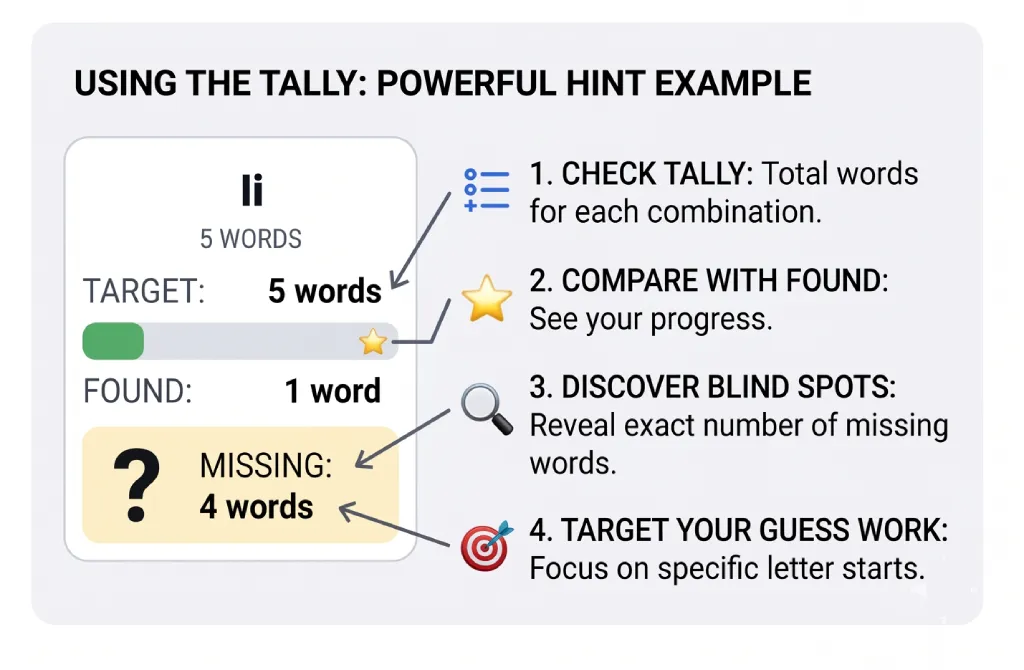
Two-Letter List, Two-Letter Hints, and Word Count by Length
The two-letter list is the most useful thing a spelling bee solver can show without naming a word. It is a grid of starting pairs and how many valid words begin with each pair. If RE shows a high count and you only have reel, you know the hive is richer than your notebook. If QA shows one word and you do not have it, you can hunt a single shape instead of wandering.
Two-letter hints are the same data with a softer name. Some players want the phrase two-letter hints because it sounds less like an answer key. Fine. Use it that way. Look at one high-count pair. Try common suffixes on that pair. Do not click the pair to expand the hidden words unless you have chosen to escalate. On our solver, answers can stay blurred while the two-letter list stays visible. That is the point of Get Hints.
Word count by length is the other non-spoiler number. If your found list is heavy on fours and the solver says you are missing sevens, start building stems. If the long-word bucket is almost empty, Genius may be a volume problem, not a secret pangram. The genius calculator pairs with that view: runway left, not which words fill it.
Together, two-letter list plus word count by length is a cross-check. A pair with many fours is a different hunt from a pair with two long words. You do not need the spelling bee solver to spell them. You need it to tell you where to look. After Get All Answers, ask which pairs you never tried. The archive makes that review calmer because yesterday’s hive is no longer a streak threat.
Pangram Highlighted, Not Pangram Pasted
A good spelling bee solver can keep the pangram highlighted — gold row, star, separate count — without forcing you to read it. That is a narrower spoiler than Get All Answers. If you want only that reveal, the pangrams page isolates the all-letter word. Leave the toggle on for a custom letter set; leave the letters unread when you are still hunting today’s hive.
A note on spoilers and this page
This article will never list today’s words. If you arrived looking for a paste-ready answer key, use the live homepage when you are ready, or stay on hints and the solver with Get Hints on. We would rather send you to the right tool than hide a spoiler in a spelling bee solver guide that ranks in search for weeks.
Conclusion: Let the Solver Wait
The best spelling bee solver is the one you can run with answers hidden. Center letter required keeps the puzzle honest. Two-letter hints, a two-letter list, and word count by length keep you working. Pangram highlighted can be a small spoiler or a teaching mark. Get Hints vs Get All Answers is the whole ethic in five words. Use the live solver and hints for structure, a custom letter set for reps, and the homepage when you are ready to be done.
Spelling Bee Hub is unofficial, independent, and built for people who like the hunt more than the paste. Skip this article next time. It will still be here when you need the rules of engagement, not the letters of the day.