
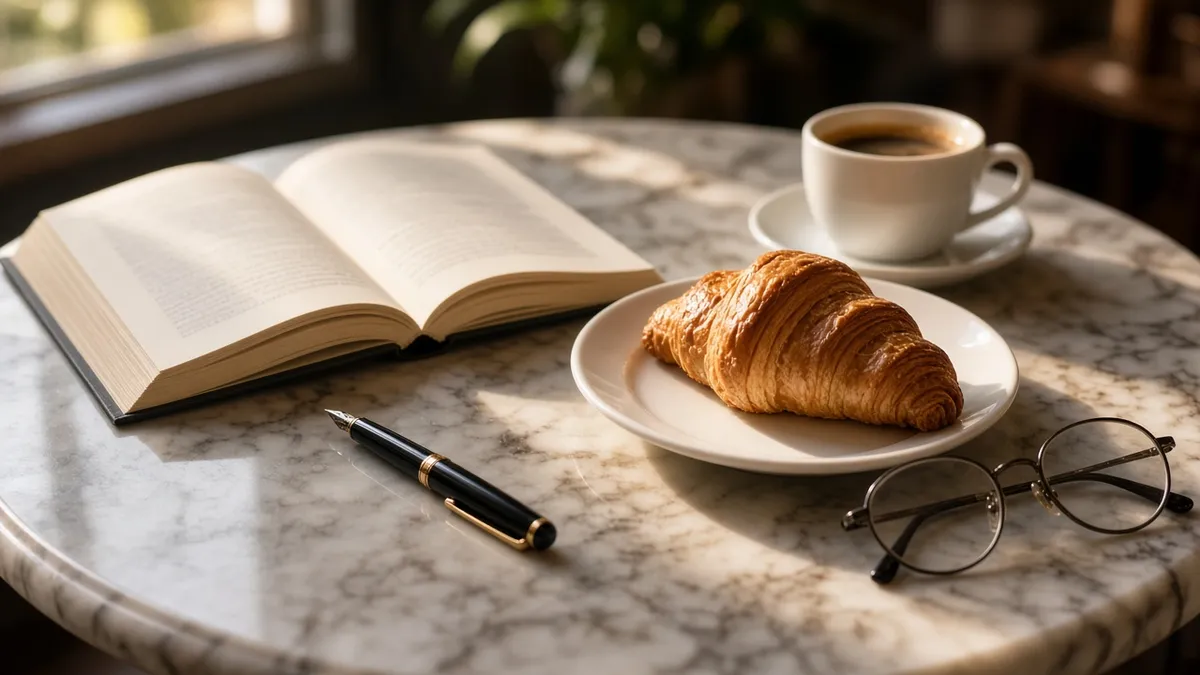
French words used in English are everywhere, from the ballet you watch to the croissant you eat and the rendezvous you plan. This guide lists 120 common French loanwords sorted by theme, explains how they came into English, and shows the spelling patterns that make them easier to spell in class, in writing and in a spelling bee.
French loanwords are favorites of spelling bee pronouncers because their spelling rarely matches how an English speaker would guess them. A word that sounds like "bu-KAY" is spelled bouquet. A word that sounds like "SHOW-fur" is spelled chauffeur. Once you learn a handful of French patterns, though, these words go from impossible to predictable. If you study with a multilingual background, our multilingual spelling bee strategies guide pairs well with this list.
How French words came into English
The biggest wave arrived after the Norman Conquest of 1066. William of Normandy took the English throne, and French became the language of the court, the law and the government, while most people kept speaking English. Over the next few centuries, thousands of French words moved into everyday English.
That history explains a famous pattern in English food words. The animals kept their English names, while the meat served at the table often took a French one:
| Animal (Old English) | Meat (from French) |
|---|---|
| cow | beef |
| pig | pork |
| sheep | mutton |
| calf | veal |
French kept lending words long after the Middle Ages, especially for food, fashion, art and dance. That is why English has both very old French loans that look fully English (justice, army, beauty) and newer ones that still look French (café, genre, déjà vu).
French words used in English, by theme
Food and cooking
- croissant, baguette, brioche, crêpe, soufflé, quiche, omelette, mousse, éclair, meringue
- sauté, flambé, purée, julienne, gourmet, cuisine, menu, restaurant, café, chef
- buffet, entrée, hors d'oeuvre, dessert, sorbet, bouillon, consommé, au gratin, à la carte, à la mode
Fashion and style
- boutique, couture, chic, beige, lingerie, silhouette, chiffon, suede, beret, corsage
- toupee, cologne, rouge, négligée, boutonniere
Arts, dance and entertainment
- ballet, ballerina, pirouette, plié, encore, genre, matinee, premiere, repertoire, ensemble
- montage, collage, debut, cabaret, connoisseur, critique, memoir, bouquet, rendezvous, souvenir
Government, law and the military
- justice, jury, verdict, attorney, bailiff, parliament, sovereign, regime, coup, bureau
- bureaucracy, lieutenant, sergeant, corps, battalion, reconnaissance, sabotage, liaison, camouflage, espionage
Everyday words that look fully English
- beauty, castle, chair, table, people, village, story, river, mountain, country
- money, pay, change, letter, question, reason, honest, hour, very, chance
French phrases used in English
- déjà vu: the feeling you have lived a moment before
- faux pas: a social mistake
- RSVP (répondez s'il vous plaît): please reply
- bon voyage: have a good trip
- c'est la vie: that's life
- en route: on the way
- joie de vivre: joy of living
- raison d'être: reason for being
- savoir-faire: know-how in social situations
- coup de grâce: a final blow
- tête-à-tête: a private conversation
- vis-à-vis: in relation to
- avant-garde: new and experimental
- cul-de-sac: a dead-end street
- carte blanche: complete freedom to act
- nom de plume: a pen name
- crème de la crème: the very best
- double entendre: a phrase with two meanings
- esprit de corps: team spirit
- laissez-faire: a hands-off approach
That gives you roughly 120 words and phrases in total.
French spelling patterns that help you spell loanwords
Most French loanwords follow a small set of endings and letter combinations. Learn these and you can spell words you have never seen.
| Sound you hear | Common French spelling | Examples |
|---|---|---|
| "ay" at the end | -et, -é, -ée | ballet, bouquet, café, purée, entrée |
| "oh" at the end | -eau, -eaux | plateau, chateau, bureau, gateau |
| "eek" at the end | -ique | boutique, technique, antique, unique |
| "k" at the end | -que | plaque, brusque, critique |
| "et" at the end | -ette | cassette, silhouette, etiquette, baguette |
| "zh" in the middle or end | -ge, -g- | beige, garage, montage, rouge |
| "sh" at the start | ch- | chef, chic, chauffeur, chalet |
| "oo" in the middle | -ou- | bouquet, rouge, souvenir, boutique |
| silent final letter | -t, -s, -x | debut, debris, faux, rendezvous |
The silent final letter is the classic trap. In debut, ballet and buffet the final t is not pronounced in English. In debris and rendezvous the final s is silent. For more on words that hide letters, see our silent letter words guide.
Words English borrowed twice
Some French words came into English twice: once from the Norman French spoken by the conquerors and again later from the French of Paris. The two versions often ended up with different spellings and meanings. These pairs are called doublets:
| Norman French route | Parisian French route |
|---|---|
| catch | chase |
| warranty | guarantee |
| warden | guardian |
Notice the pattern: Norman forms often have a w or a hard c, while the Parisian forms have gu or ch. Knowing this helps explain why guarantee starts with a silent-sounding u after the g.
French words that look English but are spelled the French way
Many French loanwords have been in English so long that people forget they are borrowed, yet they keep French spellings that trip up spellers:
- colonel: sounds like "kernel," a spelling history that mixes French and Italian forms
- debris: silent s
- depot: silent t
- chassis: the plural is spelled the same as the singular
- fiancé / fiancée: one e for the man, two for the woman, a gender difference that French spelling keeps
- naive: often written naïve, with two dots over the i
- regime: often written régime
- cliche: often written cliché
- facade: often written façade, with a cedilla under the c
The cedilla (ç) tells you the c is soft, like an s. The two dots on naïve tell you to say the vowels separately. Even when English drops these marks, the pronunciation stays.
Accent marks in English spelling
Some French loanwords keep accent marks in English (café, déjà vu, crème brûlée), while others usually drop them (cliche, debut, elite). Dictionaries often list both forms. In an oral spelling bee you say only the letters aloud, so accent marks rarely come up, but check the rules of the bee you are entering for written rounds. When writing, pick one form and use it consistently.
Tricky French-origin words for spelling bees
These are the French loanwords that most often catch good spellers:
- bourgeois: the "zh" sound is spelled -geois
- chauffeur: -eur ending and double f
- connoisseur: double n and double s
- hors d'oeuvre: sounds like "or-DURV"
- lieutenant: the -ieu- in the middle
- reconnaissance: double n, double s, and -ance
- rendezvous: one word, silent s
- silhouette: silent h and -ette
- camouflage: -ou- and -age
- surveillance: the -eill- in the middle
- renaissance: double s
- entrepreneur: -eur at the end
Study these alongside our difficult spelling bee words for a strong advanced list.
How to use language of origin in a spelling bee
In many oral bees you can ask the pronouncer for the word's language of origin. Our guide to the spelling bee pronouncer explains what you can ask. When the answer is French, run through this short checklist before you spell:
- Does the word end in an "ay" sound? Think -et or -é.
- Does it end in "oh"? Think -eau.
- Is there a "zh" sound? Think g or -ge.
- Is there an "sh" at the start? Think ch-.
- Could the last letter be silent? Think t, s or x.
This takes a few seconds and catches most French spelling traps. If the pronouncer says the word came into English through French from Latin, the spelling may look more English than French, as in justice or reason, so lean on the regular English patterns you already know. If the word is a recent borrowing, such as genre or montage, expect the spelling to stay close to modern French. Asking for a sentence is also worth it, because hearing the word in context can remind you of a version you have already seen in print.
A one-week French loanword study plan
- Day 1: food words. Read the list aloud and sort by ending (-et, -é, -ette).
- Day 2: arts and fashion words. Circle every -ou- and -que.
- Day 3: law and military words. Focus on lieutenant, reconnaissance and surveillance.
- Day 4: French phrases. Learn the meaning first, then the spelling.
- Day 5: pattern quiz. Read 20 words aloud and have the speller write them.
- Day 6: tricky list above. Spell each word twice, once slowly and once at bee speed.
- Day 7: re-test only the words you missed.
For a full bee routine, add this plan to our spelling bee preparation guide.
French borrowed much of its vocabulary from Latin; see our list of Latin root words.
French influence also explains some British and American spelling splits, such as colour and centre.
Frequently Asked Questions
What are some common French words used in English?
Common examples include ballet, café, chef, croissant, menu, restaurant, boutique, genre, souvenir and rendezvous. Phrases like déjà vu, faux pas and RSVP are also widely used.
Why does English have so many French words?
Most arrived after the Norman Conquest of 1066, when French became the language of the English court, law and government. English kept borrowing French words for food, fashion and the arts in later centuries.
Why are beef and pork French words?
After 1066, the animals kept their English names, like cow and pig, while the meat served to French-speaking nobles often took a French name. That is how beef, pork, mutton and veal entered English.
How do you spell French loanwords?
Learn the common patterns: -et or -é for an "ay" ending, -eau for "oh", -ique for "eek" and ch- for an "sh" start. Also watch for silent final letters like the t in debut.
Do accent marks count in a spelling bee?
In an oral bee you say only the letters, so accent marks rarely come up. For written rounds, check your bee's rules, and in everyday writing use one form consistently.
What is the hardest French word to spell in English?
Words like reconnaissance, connoisseur, bourgeois and hors d'oeuvre are often named as the hardest, because they have doubled letters and spellings that do not match English sounds.