
Genius is the rank every Spelling Bee player chases — but the path there depends on a scoring system that rewards word length, pangram finds, and sheer volume. Understanding the math behind the ranks turns guesswork into strategy.
1. How Spelling Bee Points Work
Every valid word in the NYT Spelling Bee earns points based on its length. The rules are simple but have outsized impact on your rank progression:
- 4-letter words are worth exactly 1 point each, regardless of which letters they use.
- Words with 5 or more letters earn points equal to their length — a 5-letter word is worth 5 points, an 8-letter word is worth 8, and so on.
- Pangrams (words using all seven hive letters) receive a flat +7 bonus on top of the word's base score.
For a complete breakdown of valid words, minimum lengths, and the center-letter rule, see our Spelling Bee rules page.
Pro Tip: Pangram Math
A 4-letter pangram earns 8 points (1 + 7). A 7-letter pangram earns 14 points (7 + 7). The bonus is always 7 regardless of length, so shorter pangrams give you more points per letter typed.
2. Rank Thresholds and the ~70% Rule
Spelling Bee ranks are calculated as percentages of the maximum possible score for that day's puzzle. The ranks, from lowest to highest, are: Beginner, Good Start, Moving Up, Good, Solid, Nice, Great, Amazing, Genius, and Queen Bee.
Genius requires roughly 70% of the total available points. The exact number varies by puzzle because the NYT rounds the threshold to a clean integer, but 70% is the reliable rule of thumb. Queen Bee — the ultimate rank — requires 100%: every single valid word in the puzzle.
Here is how the intermediate ranks typically break down:
- Good: ~2% of maximum points
- Solid: ~5%
- Nice: ~8%
- Great: ~15%
- Amazing: ~25%
- Genius: ~70%
- Queen Bee: 100%
The jump from Amazing (~25%) to Genius (~70%) is the steepest climb. That is where most players stall — and where understanding your exact point gap becomes critical.
3. Using the Genius Calculator
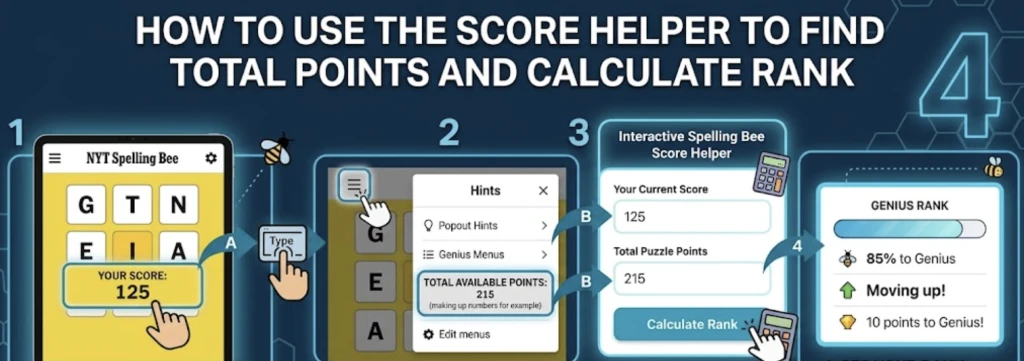
Mental math gets fuzzy when you are deep in a puzzle. Our genius calculator takes today's hive letters and tells you exactly how many points you need for each rank, including Genius. Enter your current score and it shows the gap remaining.
The calculator also works in reverse: if you know the total word count and have found the pangram, you can estimate how many more words — and of what lengths — you need to close the gap. This turns a vague "I think I am close" into a concrete plan.
For a more detailed rank-by-rank breakdown with historical comparisons, try the score and rank calculator, which adds percentile data showing how your score compares to other players on the same puzzle.
Pro Tip: Check Before You Hint
Before opening hints, run your current score through the genius calculator. If you are within 10–15 points of Genius, a targeted two-letter tally search may be all you need — no full spoilers required.
4. Scoring Strategy for Each Rank Tier
Beginner to Good (0–5%): Focus exclusively on 4-letter words. Type every combination you can see. Volume is everything at this stage — do not worry about length or pangrams yet.
Good to Great (5–15%): Start hunting 5- and 6-letter words. Look for common suffixes like -ED, -ING, and -ER that attach to 4-letter bases you have already found. Each upgrade from a 4-letter word to a 5-letter word nets you 4 additional points.
Great to Amazing (15–25%): Dedicate time to the pangram. Even if it is long, the +7 bonus plus length points can jump you an entire rank. Use the two-letter tally to identify unexplored letter pairs.
Amazing to Genius (25–70%): This is the grind zone. Mix systematic tally reading with longer word searches. Prioritize 6+ letter words when you find them — each one is worth more than six 4-letter words combined. Check the calculator frequently to track your gap.
5. Why Maximum Score Changes Daily
Every puzzle has a different maximum score depending on its word list. A puzzle with 45 words and one 9-letter pangram has a different ceiling than one with 80 words and two pangrams. That is why Genius is a percentage, not a fixed point number.
On low-word-count days, Genius might require only 80–100 points. On generous days with 70+ words, it could be 200 or more. The calculator adjusts automatically based on the day's data, so you never have to guess the ceiling.
Visit Spelling Bee Hub's homepage for today's answers and maximum score, then plug the numbers into the calculator to see exactly where you stand.
Conclusion: Know the Math, Play Smarter
Genius is not a mystery — it is 70% of a number you can calculate. Learn the scoring rules (4-letter = 1 point, longer = length, pangram = +7), use the genius calculator to track your gap, and adjust your strategy at each rank tier. The players who reach Genius consistently are not lucky — they understand the math.