
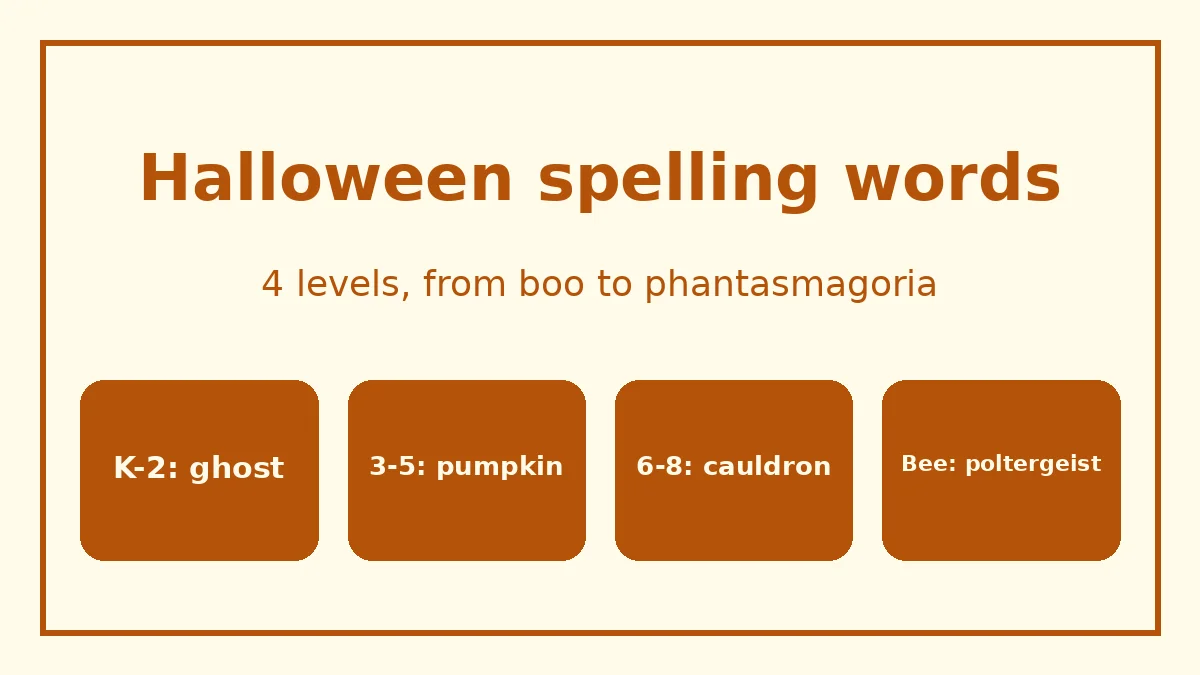
These Halloween spelling words are sorted into four levels, from bat and boo for kindergarten up to poltergeist and phantasmagoria for a school spelling bee final. Each list has a short note on the letters that trip students up, so you can run a themed practice round, a classroom bee or a spooky family quiz without hunting for words the week before 31 October.
Halloween falls on Saturday, 31 October 2026, which means most schools will hold their themed day on Friday 30 October. That gives you about two weeks to practice. If you are planning a full classroom event, pair this list with our step-by-step guide on how to run a classroom spelling bee.
How to use these Halloween spelling words
Every word below is a standard English dictionary word. We checked the trickier spellings and word origins against Merriam-Webster and the Online Etymology Dictionary, and we kept the lists free of gore so they suit a mixed-age classroom.
- Level 1 (K to grade 2): short, phonetic words with one tricky sound each.
- Level 2 (grades 3 to 5): two- and three-syllable words with double letters and silent letters.
- Level 3 (grades 6 to 8): longer words with unusual vowel patterns.
- Level 4 (spelling bee champions): words borrowed from German, Greek, French and Irish that reward knowing the language of origin.
Mix levels freely. A grade 4 class can usually handle most of Level 2 and a few Level 3 words, and a family game works best with one word from each level per round.
Level 1: Halloween spelling words for K to grade 2
| Word | Watch out for |
|---|---|
| bat | short a |
| boo | double o |
| cat | c, not k |
| owl | ow, not ou |
| web | short e |
| moon | double o |
| mask | sk ending |
| broom | br blend, double o |
| ghost | silent h after g |
| witch | silent t before ch |
| candy | y ending sounds like ee |
| night | igh pattern |
Teaching tip: ghost, witch and night each hide a silent letter. Say the word, then ask students which letter they cannot hear. It turns a spelling test into a small mystery, which suits the theme.
Level 2: Halloween spelling words for grades 3 to 5
| Word | Watch out for |
|---|---|
| pumpkin | m before p, not n |
| costume | ends in -ume |
| skeleton | three e's, one of them unstressed |
| monster | -er ending |
| spider | one d |
| haunted | au, not aw |
| lantern | -ern ending |
| goblin | -lin, not -len |
| scarecrow | compound: scare + crow |
| shadow | -ow ending |
| treats | ea vowel team |
| howling | ow, then -ing |
| creepy | double e, then y |
| mummy | double m |
Teaching tip: pumpkin is the most commonly misspelled word on this list, because many people say "punkin". Ask students to hum the m before the p so they feel the lips close.
Level 3: Halloween spelling words for grades 6 to 8
| Word | Watch out for |
|---|---|
| cauldron | au, then -dron |
| cemetery | three e's; no -ary ending |
| vampire | -ire ending |
| werewolf | were-, not wear- |
| silhouette | silent h, -ouette ending |
| apparition | double p, one r |
| bewitched | silent t before ch |
| nocturnal | -urnal ending |
| phantom | ph spells the f sound |
| sorcerer | -erer, three r's in all |
| gargoyle | -oyle ending |
| eerie | double e, then -rie |
| ominous | -ous ending |
| jack-o'-lantern | two hyphens and an apostrophe |
Teaching tip: cemetery comes from the Greek koimeterion, "sleeping place", according to the Online Etymology Dictionary. Students who remember the three e's as three sleeping figures tend to stop writing "cemetary".
Jack-o'-lantern is a good test of punctuation as well as letters. Merriam-Webster spells it with two hyphens and an apostrophe, and records its first known use in 1667. In a spoken bee, ask students to spell it aloud and say "hyphen" and "apostrophe" in the right places.
Level 4: Halloween spelling bee words for champions
| Word | Origin | Watch out for |
|---|---|---|
| poltergeist | German | -geist, not -guist |
| lycanthrope | Greek | lyc- with a y |
| macabre | French | -abre ending |
| sepulcher | Latin | -cher in US spelling (UK: sepulchre) |
| banshee | Irish | -shee ending |
| catacomb | Latin | silent b at the end |
| sarcophagus | Greek | ph, then -agus |
| ectoplasm | Greek | ecto- prefix |
| mausoleum | Greek (via Latin) | au, then -oleum |
| incantation | Latin | -tation ending |
| talisman | via Arabic and Greek | one s, -man |
| phantasmagoria | Greek (via French) | ph, then -asma- |
Why origin matters: in a formal bee, a speller may ask for the language of origin. Knowing a word is German tells you that ei and ie usually sound like "eye" and "ee", so poltergeist ends in -geist. The Online Etymology Dictionary traces poltergeist to German poltern, "make noise, rattle", plus Geist, "ghost", so the word literally means "noisy ghost". Lycanthrope comes from Greek lykanthropos, "wolf-man", which explains both the y and the -thrope ending.
For more words at this level, our list of the most difficult spelling bee words covers famous championship words, and the Scripps word lists show what official school bees use.
Halloween spelling words with tricky patterns
If you only have five minutes, drill the patterns rather than the whole list:
- Silent letters: ghost, witch, bewitched, silhouette, catacomb.
- Double letters: boo, broom, mummy, eerie, apparition.
- ph for f: phantom, sarcophagus, phantasmagoria.
- au and aw: haunted, cauldron, mausoleum.
- Endings that sound alike: lantern and cauldron, monster and sorcerer, ominous and nocturnal.
Grouping words this way is the same trick competitive spellers use with prefixes and suffixes. Our guide to spelling bee prefixes and suffixes shows how it works for harder words.
How to run a Halloween spelling bee
A themed bee does not need much more than a word list and a few rules everyone hears before round one:
- Pick the level by grade, then add one stretch word per round. It keeps strong spellers interested without knocking out everyone else.
- Say the word, use it in a sentence, say it again. "Cauldron. The witch stirred the cauldron. Cauldron."
- Allow the standard requests: definition, sentence, language of origin and part of speech.
- Keep costumes away from the microphone. Masks muffle letters, so ask spellers to lift them when it is their turn.
- Use eliminations only in the final rounds. Early rounds work better as practice where everyone writes the word on a whiteboard.
For printable study plans and timing, see how to prepare for a spelling bee. For year-round grade lists that are not seasonal, use our 2026 spelling bee word list by grade.
Ready-made sentences for the trickiest words
A good bee sentence gives context without giving the spelling away. Here are sentences you can read aloud for the words students miss most often:
- pumpkin: "We carved a pumpkin with a crooked grin."
- skeleton: "The skeleton costume glowed in the dark."
- haunted: "Nobody wanted to walk past the haunted house after dark."
- cauldron: "Steam curled up from the bubbling cauldron."
- cemetery: "The old cemetery had moss on every stone."
- silhouette: "A bat's silhouette crossed the full moon."
- apparition: "She thought she saw an apparition at the window, but it was only a curtain."
- eerie: "The empty hallway was quiet and eerie."
- poltergeist: "In the story, a poltergeist kept slamming the kitchen cupboards."
- macabre: "The museum display was more macabre than the children expected."
- catacomb: "Tourists followed a guide through the narrow catacomb."
- phantasmagoria: "The light show was a phantasmagoria of shifting shapes."
Write your own sentences for the rest of the list the night before. Keep them short, avoid using a word that shares the same root, and never spell part of the word inside the sentence.
Halloween word games beyond the spelling test
Spelling lists work best when students meet the words more than once. A few low-prep ideas:
- Spooky word ladder: change one letter at a time to get from bat to cat to cap to map.
- Hidden word hunt: how many smaller words can students find in "scarecrow"? Scare, care, car, crow, row and cow are all inside it.
- Make a mini hive: pick seven letters from a Halloween word and list every word you can build, just like the NYT puzzle. Our guide to making your own Spelling Bee puzzle shows how to choose letters that work.
- Play the daily hive: once the class is warmed up, open our free Spelling Bee game on the board and solve it together.
Checklist: your Halloween spelling bee
- [ ] Choose one level per grade and pick 10 to 15 words.
- [ ] Add one stretch word per round from the next level up.
- [ ] Print the word list for students one week ahead.
- [ ] Prepare a sentence for every word so you are not inventing them live.
- [ ] Decide the rules for requests (definition, origin, sentence) and announce them first.
- [ ] Run practice rounds on whiteboards before any eliminations.
- [ ] Keep a dictionary nearby to settle disputes.
Next up for November: our Thanksgiving spelling words, from pie to succotash.
Planning ahead? Our Christmas word lists follow the same format.
Frequently Asked Questions
What are good Halloween spelling words for kids?
For K to grade 2, try bat, boo, cat, owl, web, moon, mask, broom, ghost, witch, candy and night. Each one is short but practices one tricky pattern, such as the silent h in ghost.
What are hard Halloween spelling bee words?
Poltergeist, lycanthrope, macabre, sepulcher, sarcophagus, mausoleum and phantasmagoria are good championship words. Most come from German, Greek or French, so knowing the language of origin helps.
How do you spell jack-o'-lantern?
Merriam-Webster spells it j-a-c-k, hyphen, o, apostrophe, hyphen, l-a-n-t-e-r-n. The apostrophe stands in for the missing letters of "of".
Is it cemetery or cemetary?
The correct spelling is cemetery, with three e's. It comes from the Greek koimeterion, meaning "sleeping place", and has no -ary ending.
Where does the word Halloween come from?
The Online Etymology Dictionary traces Halloween to a Scottish shortening of All Hallows' Even, the evening before All Saints' Day. Hallow is an old word for a holy person or saint.
How many words should a Halloween spelling bee have?
For a classroom bee, plan 10 to 15 words per level and about two words per student for each round. Keep a few spare stretch words for tie-breakers in the final.