
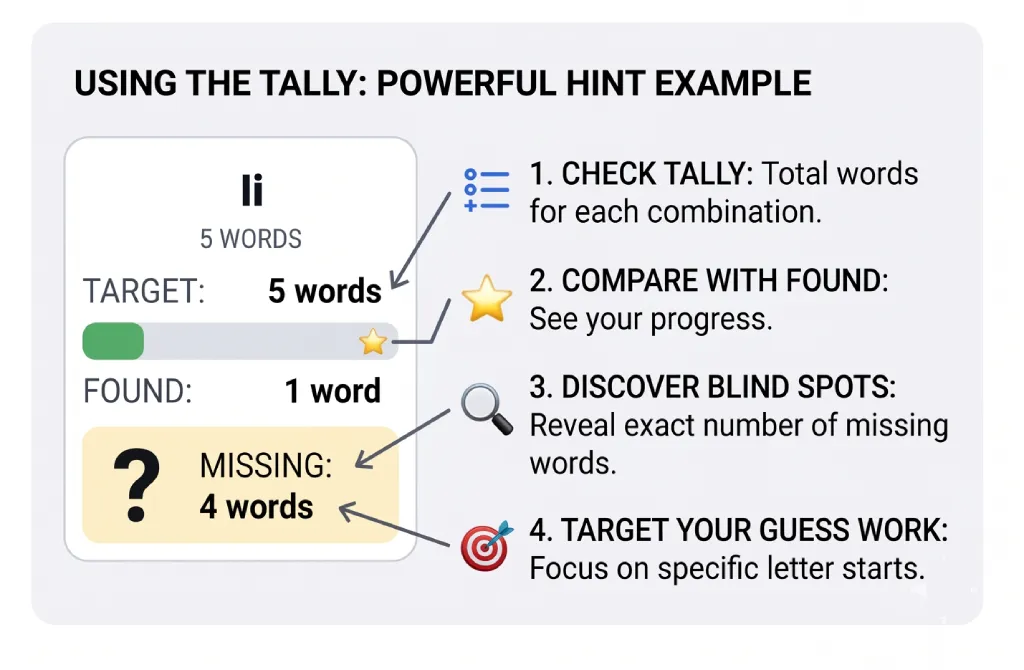
Stuck at Good and cannot name what is missing? The two-letter tally (often called the 2-letter list or 2LL) is the most efficient spoiler-light hint in NYT Spelling Bee. It tells you how many answers begin with each letter pair—without showing the words.
Community solvers adopted the grid long before it became a standard hint format. The Spelling Bee forum culture around pair hunting is part of the game’s social history described in Wikipedia’s overview of the NYT Spelling Bee.
What Is the Two-Letter Tally?
For today’s hive, every accepted word of length four or more has a two-letter prefix (for example, ST in star). The tally aggregates counts: if ST shows 3, exactly three answers start with S then T using legal hive letters.
That is different from “how many words start with S?”—the first-letter breakdown is broader. Pair counts localize your search. Our live Spelling Bee hints page publishes the tally alongside length breakdowns for November 7, 2026.
How to Read the Grid
Think of the tally as a heat map:
- Sort by count. High cells (4–6 words) are efficient point farms.
- Mark progress. When you find a word, decrement your mental count for its pair.
- Cross-reference length. If only one 8-letter word remains, pair counts plus length hints narrow candidates fast.
| Signal in tally | What to do |
|---|---|
| Single count in a weird pair (e.g., VU) | Expect jargon or archaic vocabulary—common in Queen Bee sweeps. |
| Zero for a letter as first character | No bingo word starts with that letter today—stop forcing it. |
| Many high counts on one row | That letter likely sits in the center or anchors many stems. |
Bingo Check
A Spelling Bee bingo means each hive letter starts at least one word. Scan the tally’s first letters of each pair: if every outer letter plus the center appears as the opening character of some pair with a non-zero count, the puzzle is a bingo.
Bingos are an early-game milestone. They force coverage across the hive and often unlock longer words you skipped while chasing four-letter speed.
Genius Push Strategy
Genius typically requires roughly 70% of available points. Once common words dry up, stop random typing. Open the tally, pick the largest remaining counts, and exhaust plausible combinations for those pairs only.
Pair this with affix sweeps from our prefix and suffix guide: many late Genius words are a root you already found plus RE-, UN-, or -ING.
Queen Bee Sweep
Queen Bee means 100% of answers. The tally is the operational tool: when one cell still shows 1 and you cannot find it, you know which pair to brute-force systematically. For mindset and archive study, read how to reach Queen Bee.
Track “orphan” cells with count 1—they hide difficult Bee words more often than high-count rows.
Common Mistakes
- Opening the full answer list too early. You cannot unsee words; tallies preserve discovery.
- Ignoring length hints. Pair + length together beat either alone.
- Chasing impossible first letters. A zero row saves minutes.
- Skipping pangram pairs. Long pairs with count 1 may be the pangram stem—check today’s pangram hints.
Today's Two-Letter Pair List (November 7, 2026)
Live hive: center I, outer letters A, D, E, L, M, V. Total accepted words in our database for this date: 77. Expand the list below to see pair counts—still spoiler-free (no individual words).
Show 23 two-letter pairs for November 7, 2026 Tap to expand
| Pair | Word count |
|---|---|
| DI | 16 |
| LI | 8 |
| MI | 8 |
| MA | 5 |
| VI | 5 |
| AI | 4 |
| ID | 4 |
| AV | 3 |
| DE | 3 |
| ME | 3 |
| AL | 2 |
| EL | 2 |
| EM | 2 |
| LA | 2 |
| VE | 2 |
| AM | 1 |
| DA | 1 |
| ED | 1 |
| EV | 1 |
| IM | 1 |
| IV | 1 |
| LE | 1 |
| VA | 1 |
Want interactive filters? Use today’s hints hub or the solver with the same letters.
Paper Tracking Template
Draw a small table on scratch paper with two columns: Pair and Remaining. Copy only pairs with count ≥2 first. When you find a word, subtract one from that pair row. When a row hits zero, strike it out. This manual sync prevents double-searching the same stem.
Hint Tiering Discipline
Move through hint tiers in order: first-letter counts, two-letter tally, length grid, definitions last. Skipping tiers feels faster but spoils more than necessary. Tiering preserves learning while preventing rage-quits.
Group Solves With Tallies
In group chats, share tally screenshots instead of word lists. Friends can collaborate on which pair still needs work without naming answers—a social compromise between competition and spoilers.
Digital vs. Paper Tally Sync
Some players screenshot the tally and mark it in a photo editor; others copy counts to notes apps. Pick a method that updates in under ten seconds when you find a word—friction kills compliance during fast sessions.
Advanced Pair Arithmetic
Sum all counts in the tally mentally and compare to words found. If your found count plus remaining tallies does not match published word totals on hint pages, you mis-marked a pair or missed a duplicate stem.
When multiple pairs share a first letter, prioritize the letter with highest aggregate count—that letter’s ecosystem probably anchors the puzzle theme.
On days with zero words for a first letter, redirect all effort away from that letter as a starter; it can still appear inside words.
Closing Practices for Daily Players
Daily puzzles reward repeatable rituals more than sporadic marathons. Keep a single notebook for hive letters, tally notes, and one new word learned per session. Review the notebook weekly to see which suffixes and roots repeat—those repetitions are the real curriculum the editor teaches through letter selection.
Pair your reading habits with play: news articles, novels, and nonfiction expose you to vocabulary that reappears in hives. When you recognize a word from reading, log which letters made it possible. That connection turns passive reading into active Bee training without flashcard drudgery.
Share spoiler-light tips with friends—pair counts, bingo status, pangram length—rather than full lists. Social play stays fun when everyone still gets discovery moments. When you need structured help, use Spelling Bee Hub hints, archive pages, and solvers in that order so learning sticks.
Frequently Asked Questions
Is the two-letter tally cheating?
That is a personal line. Most players treat tallies like crossword checking a crossing—structure without answers.
Do pairs include the center letter?
Pairs use hive letters only. Every word must still contain the center letter somewhere, not necessarily in the first two slots.