
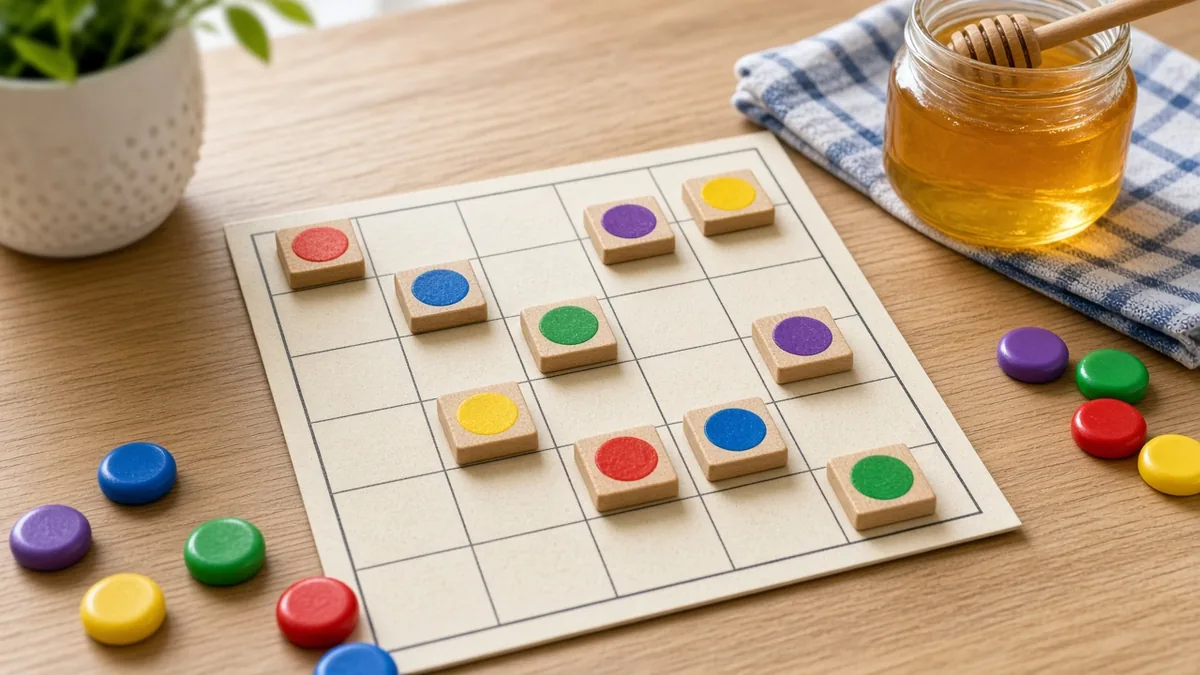
In Spelling Bee talk, a bingo is a puzzle where every one of the seven letters starts at least one accepted word. The New York Times glossary puts it this way: "All seven letters in the puzzle are used to start at least one word in the word list." It is not a score, a rank or a badge in the game. It is a feature of the day's word list that players notice and talk about.
This guide explains what bingo means in Spelling Bee, how to tell whether today's puzzle is a bingo before you finish, why it matters for finding the last few words, and how it differs from a pangram. If you want the short definitions of every term, our Spelling Bee glossary has them all on one page.
What does bingo mean in Spelling Bee?
A Spelling Bee puzzle has seven letters: one center letter that every word must use and six outer letters. On a bingo day, the official answer list contains at least one word that begins with each of those seven letters, including the center letter.
Three points cause most of the confusion:
- It is about the answer list, not about you. A puzzle is a bingo whether or not you find those words. You "get the bingo" when you have found a word starting with each letter.
- It is not a pangram. A pangram is a single word that uses all seven letters. A bingo is spread across the whole list. Every puzzle has at least one pangram; not every puzzle is a bingo.
- It does not change your score. The NYT scoring rules give four-letter words one point, longer words one point per letter, and a pangram seven extra points. There are no points for a bingo.
Where the term comes from
The word came from the solving community, not from the game itself. The Spelling Bee Solver glossary says "bingo" was coined by a Times Wordplay commenter who goes by qatburger, and it has since become standard shorthand in the Hivemind. The NYT's own Spelling Bee glossary, compiled for the Spelling Bee Forum, lists it alongside 2LL, GN4L and QB.
The name fits the idea of a bingo card: seven starting letters, and you want a mark next to every one. If you are new to the shorthand, our beginner's guide and the Spelling Bee rules page explain the basics first.
How to tell if today's puzzle is a bingo
You do not need to finish the puzzle to know. There are three reliable ways to check.
1. Read the grid
The NYT's daily Spelling Bee Forum post includes a grid. According to the NYT glossary, the left column shows the first letter of each word and the top row shows word length, with sigma (Σ) columns for totals. If all seven letters appear in the left column with a total above zero, the puzzle is a bingo. If a letter is missing from the column, no answer starts with it.
2. Read the two-letter list
The two-letter list (2LL) gives the number of accepted words that begin with each pair of letters, such as "BA-3" or "TR-2". Look at the first letter of every pair. If all seven letters appear as a first letter at least once, it is a bingo. Our guide to mastering the two-letter tally shows how to use the list as a checklist.
3. Use spoiler-safe hints
Our Spelling Bee hints page shows the grid and two-letter list for today's puzzle, so you can confirm a bingo without seeing any answers. Our today's analysis page summarizes the word list's shape for the day.
Why a bingo helps you find more words
Knowing it is a bingo day turns a vague "there must be more words" into a specific search. A typical pattern is to have plenty of words starting with S, T or R and none at all starting with the awkward letter in the hive. If you know the puzzle is a bingo, you know that awkward letter starts at least one word, and it is often one of the last words people find.
Try this routine when you stall:
- List the seven letters and tick each one that already starts a word you have found.
- Any unticked letter on a bingo day is a guaranteed target.
- Try that letter with each of the others as a second letter. Two-letter openings like "CL", "EN" or "UN" can be productive, but use only the letters in the hive.
- Check prefixes and suffixes built from the hive's letters. Our guide to Spelling Bee prefixes and suffixes lists the common ones.
- If you are still stuck, a single grid hint for that letter is a gentle nudge rather than a spoiler.
Here is how that looks in practice. Imagine a hive with the center letter A and outer letters C, H, L, N, P and T, and you have found twenty words. You tick C, H, P and T as starting letters, but nothing yet starts with A, L or N. On a bingo day, those three letters are now your whole search: words opening with AN, LA or NA are where the missing points are. On a non-bingo day, the grid tells you which of the three to skip.
Letters that make a bingo harder
Some letters begin far fewer English words than others, so they are the usual reason a puzzle is not a bingo. Letters such as X, Z, Q, J and Y start relatively few common words, and Spelling Bee also leaves out words that are obscure, offensive, hyphenated or proper nouns. When one of those letters is in the hive, check the grid before assuming a word starting with it exists.
The center letter is different. Every word must contain it, but that does not mean any word begins with it. A center letter like Y or X can appear in dozens of words and still start none of them.
Bingo vs pangram vs perfect pangram
| Term | What it means | Scored? |
|---|---|---|
| Bingo | Each of the seven letters starts at least one word in the list | No |
| Pangram | One word that uses all seven letters at least once | Yes, +7 points |
| Perfect pangram | A pangram that uses each letter only once, so seven letters long | Yes, +7 points (same bonus) |
| Queen Bee | Finding every word in the list | Rank shown only when complete |
Pangrams and perfect pangrams are covered in detail in perfect pangrams explained and how to find the pangram every day. If your goal is the full list, how to reach Queen Bee explains why the bingo check is a standard step for many solvers on the way to QB.
Other Hivemind shorthand you will see next to bingo
Bingo usually appears in forum comments with other abbreviations. The NYT glossary defines these:
- 2LL: two-letter list.
- GN4L: Genius with no four-letter words.
- GNP: Genius with no pangram.
- QB: Queen Bee, every word found.
- QBABM: Queen Bee all by myself, with no hints.
- QB-1: one word away from Queen Bee.
So a comment like "bingo, GN4L, then QB-1 for an hour" means the solver found a word for every starting letter, reached Genius without four-letter words, then got stuck one word short of the full list.
Does bingo show up anywhere in the game?
No. The NYT Spelling Bee does not display a bingo message, and bingos are not among the in-game achievements. If you are interested in what the game does track, our recent post on NYT Spelling Bee badges covers that. Bingo stays a community term.
Two other recent guides fit naturally with a bingo hunt. Long words often start with the letter you are missing, so the longest word in Spelling Bee is worth reading. And if you are sure a word starting with your missing letter should count, how to suggest a word to Spelling Bee explains how to send it to the editors.
Bingo and the rest of NYT Games
Spelling Bee is the only NYT game where "bingo" has this meaning. Other games have their own terms and their own scoring, and our new NYT games list gives a quick guide to every puzzle in the lineup, including which ones are free.
Party ideas with bingo
Pair bingo with a full spelling bee night for adults.
Checklist: using bingo to finish a puzzle
- [ ] Check the grid or two-letter list to see whether today is a bingo.
- [ ] Tick each letter that starts a word you have found.
- [ ] Hunt the unticked letters first; on a bingo day each one starts at least one word.
- [ ] Try two-letter openings built only from the hive's letters.
- [ ] Remember the center letter must appear in every word but may not start any.
- [ ] Use one grid hint per letter before reaching for full answers.
Frequently Asked Questions
What does bingo mean in Spelling Bee?
It means each of the seven letters in the puzzle starts at least one word in the official answer list. The NYT glossary defines it as all seven letters being used to start at least one word.
Is a bingo the same as a pangram?
No. A pangram is one word that uses all seven letters. A bingo describes the whole word list: at least one word begins with each letter.
Do you get points for a bingo?
No. Spelling Bee scores words only: one point for a four-letter word, one point per letter for longer words, and seven extra points for a pangram.
How do I know if today's Spelling Bee is a bingo?
Check the grid or the two-letter list. If all seven letters appear as first letters with at least one word, the puzzle is a bingo. Our hints page shows both without spoilers.
Who came up with the term bingo?
The Spelling Bee Solver glossary credits a Times Wordplay commenter known as qatburger. It is a community term, not an official game feature.
Can the center letter be missing from a bingo?
Not on a bingo day. A bingo needs a word starting with every letter, the center letter included. On other days the center letter may appear in every word without starting any.