
Hunting for the Spelling Bee longest word is one of the most satisfying parts of the daily puzzle. One long word can be worth as much as five or six short ones, and it often turns out to be the pangram. This guide explains how scoring rewards long words, how long a Spelling Bee word can be, where the longest word usually hides, and a simple routine for finding it without looking at the answers.
Why the longest word matters so much
The New York Times scores Spelling Bee words by length. Four-letter words are worth 1 point. Longer words earn 1 point per letter, so a six-letter word scores 6 and a ten-letter word scores 10. A pangram, a word that uses all seven letters at least once, earns its length plus a 7-point bonus.
That makes long words the fastest route up the ranks:
| Word | Points |
|---|---|
| Any 4-letter word | 1 |
| A 7-letter word that is not a pangram | 7 |
| A 7-letter pangram | 14 |
| A 10-letter word that is not a pangram | 10 |
| A 10-letter pangram | 17 |
A 10-letter pangram is worth seventeen four-letter words. If you are chasing Genius, our Genius points guide shows how much of the day's total that can be.
How long can a Spelling Bee word be?
There is no fixed maximum. The rules say words must be at least four letters long, must include the center letter and may use only the seven letters in the hive, but letters can be used more than once. That is why a puzzle with only seven letters can contain a ten-, eleven- or twelve-letter word.
What does limit length is the word list. The NYT's puzzle editor curates it, and the published rules exclude words that are obscure, hyphenated, proper nouns or offensive. Very long technical words are often left out for that reason, so the longest answer of the day is usually a familiar word with a few extra letters added.
Where the longest word usually hides
Long Spelling Bee words tend to come from the same few patterns.
1. The pangram, stretched
Many days, the longest word is a pangram or a longer form of it. Once you find one pangram, try adding endings or prefixes that reuse its letters. Our guide to finding the pangram every day shows how to spot the base word.
2. Repeated letters
Because letters can repeat, words with doubled or tripled letters run long: think of words with two Ts, two Ns or a repeated syllable. Scan the hive for letters that commonly double in English (L, S, T, N, E, O) and test longer spellings.
3. Suffixes and prefixes
If the hive contains the right letters, endings such as -ING, -ED, -ER, -TION or -ATE, and starts such as RE-, UN- or IN-, can turn a seven-letter word into a ten-letter one. Our prefixes and suffixes guide lists the combinations that appear most often.
4. Compound words
Two short words joined together (without a hyphen, since hyphenated words are excluded) can produce a long answer. If you have found two common four-letter words that share the center letter, see whether they combine.
An example from an imaginary hive
To show the idea, imagine a hive with the letters A, C, E, I, N, T and V. (This is a made-up example, not a real puzzle, and the NYT's list may differ.)
- ACTIVATE uses A, C, T, I, V and E. It is 8 letters, so it scores 8, but it is not a pangram because there is no N.
- INACTIVE uses all seven letters. It is an 8-letter pangram worth 8 + 7 = 15.
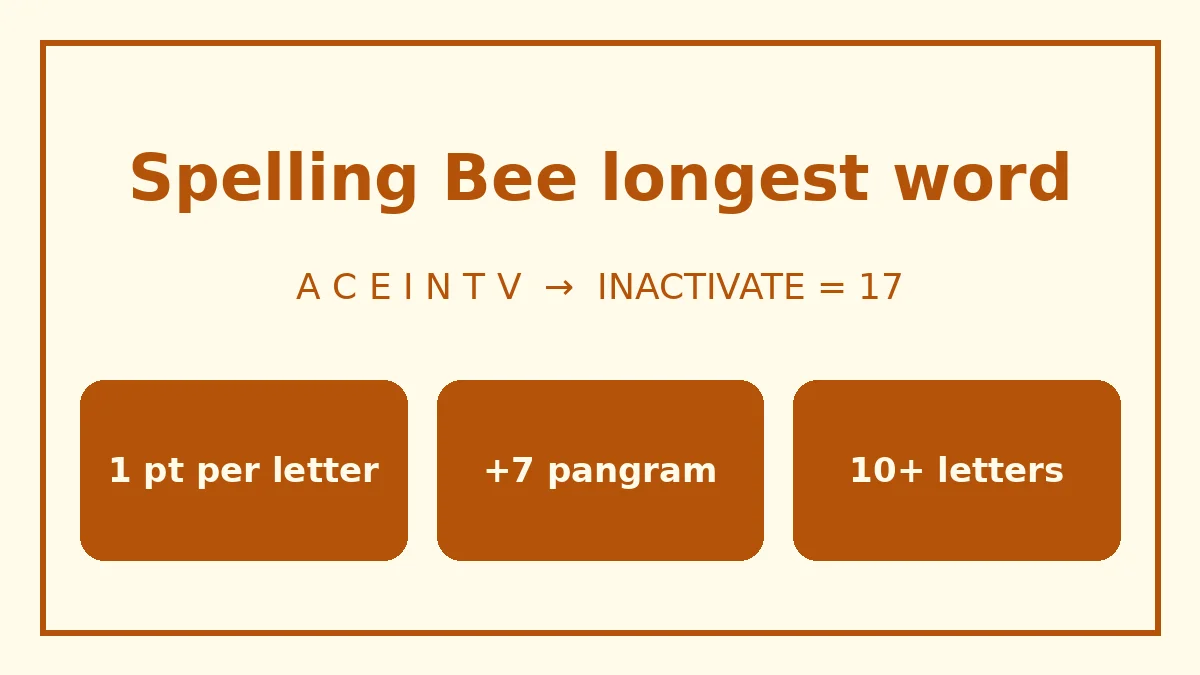
- INACTIVATE also uses all seven letters, with A, I and T repeated. It is a 10-letter pangram worth 10 + 7 = 17.
Notice the pattern: finding INACTIVE first makes INACTIVATE much easier to spot, because it is the same word with letters you already have added on. That is the "stretch the pangram" habit in action.
Endings to test, and the letters they need
Before you start stretching words, check which endings the hive can actually make. Every letter in an ending must be in the hive.
| Ending | Letters needed | Example stretch |
|---|---|---|
| -ED | E, D | PLANT → PLANTED |
| -ER | E, R | TEACH → TEACHER |
| -ING | I, N, G | PAINT → PAINTING |
| -ATE | A, T, E | ACTIV- → ACTIVATE |
| -TION | T, I, O, N | ROTATE → ROTATION |
| -NESS | N, E, S | Almost never possible: hives normally have no S |
| RE- | R, E | TREAT → RETREAT |
| UN- | U, N | TIDY → UNTIDY |
The examples show the shape of each stretch; whether a given word is accepted depends on that day's list. The -NESS row is a reminder of a quirk worth knowing: Spelling Bee normally leaves S out of the hive, so plurals and -NESS words almost never appear. The one famous exception was the 2,500th puzzle on 12 March 2025, which included S as a one-off celebration; the next day the game returned to its usual no-S format. Our post on why there is no S in Spelling Bee explains the choice.
A quick scan of this table at the start of each puzzle tells you which long-word routes are open. If the hive has I, N and G, -ING forms are worth checking for almost every verb you find. If it has R and E, check RE- starts. And if it has A, T and E, test -ATE forms on every long stem (and -ATED if D is in the hive too), since they add three or four letters at once.
A daily routine to find the longest word
- Find a pangram first. Pangrams are the most common starting point for long words.
- List the hive's suffix letters. Can you make -ING, -ED, -ER or -ATE? Write down which endings are possible.
- Stretch every long word you find. For each word of seven letters or more, try adding each possible ending and prefix.
- Use the two-letter list. The grid of two-letter starts tells you how many words begin with each pair, and the length table shows how many long words remain. Our two-letter tally guide explains how to read it.
- Check today's word count. Our page on how many words are in Spelling Bee today shows the total, so you know whether long words are still missing.
- Take a hint, not the answer. If you are stuck, try the Spelling Bee hints page before you open the full list.
The Long Word badge
Long words count for more than points. Yesterday's guide to NYT Spelling Bee badges explains that the NYT Games badge list, as compiled by Beebom, includes a Long Word badge for finding a word of 10 or more letters, with milestone levels. So every ten-letter find also moves you toward the next badge level.
When the longest word is not accepted
Sometimes you are sure your long word is real, but the game rejects it. Common reasons:
- It is hyphenated or usually written as two words.
- It is a proper noun or usually capitalized.
- The editor considers it obscure, technical or regional.
- It is offensive or primarily a slur.
None of that means you misspelled it. Our explainer on why your word wasn't accepted goes deeper, and if you want to understand how the list is built, read how the Spelling Bee dictionary is chosen. If you are sure it belongs, send the editors a word suggestion.
Spelling Bee longest word today: where to check
If you have played and want to confirm the day's longest answer, our today's Spelling Bee answers page lists every word, sorted so the long ones are easy to spot. If you missed yesterday's puzzle, check yesterday's answers. Try to find the longest word yourself first: the moment you spot it is the best part of the game.
Long word habits that pay off over time
Players who reliably find long words tend to share a few habits:
- They read the hive as syllables, not letters. Spotting "ING", "TION" or "ATE" in the hive at a glance makes long words jump out.
- They save the pangram for later stretching. Instead of celebrating and moving on, they treat the pangram as a base word.
- They note recurring long words. Some long answers come back when the same letter sets reappear. Our list of the most common Spelling Bee words is a good place to build that memory.
- They keep it fun. Hunting for the longest word is a mini-game inside the game. Treat it as a bonus challenge, not a chore.
Frequently Asked Questions
How long can a Spelling Bee word be?
There is no fixed maximum. Words must have at least four letters, include the center letter and use only the hive's seven letters, but letters can be reused, so words of ten letters or more are possible.
How many points is the longest word worth?
Words longer than four letters score one point per letter, so a 10-letter word is worth 10 points. If it is also a pangram, it earns a 7-point bonus, for 17 points in total.
Is the longest word always the pangram?
No, but it often is, or it is a longer form of the pangram. Once you find a pangram, try adding endings and prefixes that reuse its letters.
Why was my long word not accepted?
The NYT's rules exclude words that are obscure, hyphenated, proper nouns or offensive. A real dictionary word can still be missing from the curated list.
Is there a badge for long words in Spelling Bee?
Yes. The NYT Games badge list compiled by Beebom includes a Long Word badge for finding a word of 10 or more letters, with milestone levels.
Where can I see today's longest Spelling Bee word?
Our today's Spelling Bee answers page lists every word in the puzzle, so you can confirm the longest one after you have played.