
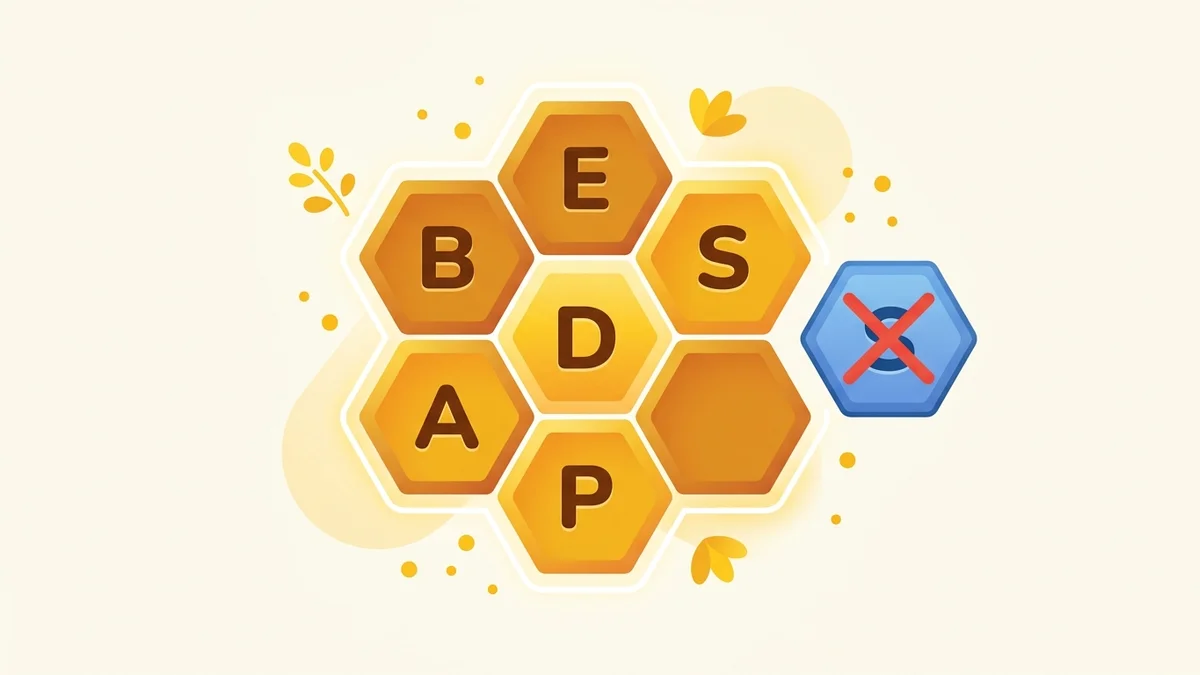
There is no S in Spelling Bee because one letter would produce a plural for almost every noun you find. Put S in the hive and BOOK, BOOKS, COOK and COOKS all count. The word list balloons and the prestigious Genius rank means significantly less. The New York Times has deliberately kept S out of the daily puzzle for nearly all of its history, with just three confirmed exceptions.
The Short Answer: S Turns Every Noun into Two Words
Scoring explains it best. A four-letter word earns 1 point. Longer words earn one point per letter, and a pangram earns 7 bonus points. (You can check the full breakdown on our Spelling Bee rules and scoring page.)
Now add S. Every noun you uncover gets an instant twin that is one letter longer, and every verb gets a third-person singular form. BLOCK becomes BLOCKS. LOOK becomes LOOKS, and that leap from 4 to 5 letters transforms a modest 1-point word into 5 points.
That introduces two fundamental problems the puzzle designers deliberately avoid:
- The list grows without getting more interesting. You get a flood of words, but zero extra variety or cleverness.
- The skill changes into repetitive bookkeeping. Instead of searching your vocabulary, you find a word, tack on an S, and repeat.
Sam Ezersky, who edits the daily puzzle, noted that he does not plan to make S a regular fixture because plurals make the game far too easy.
Has Spelling Bee Ever Used an S?
Yes. We can confirm three historic dates when the letter S was included in the NYT hive:
| Date | What Happened | Center Letter | Pangram |
|---|---|---|---|
| March 12, 2025 | The 2,500th Spelling Bee milestone. NYT Games featured S as a playful thank-you to fans who had asked for it for years. | F | FABULOUS |
| September 2, 2025 | The second S puzzle (letters B, C, H, K, L, O, S) with 40 accepted answers. | B | SCHOOLBOOK / SCHOOLBOOKS |
| May 29, 2026 | The third S puzzle (letters A, E, K, Q, S, U, Y) featuring 41 answers. | A | SQUEAKY |
The complete answer list for the May 29 hive is available in our database: May 29, 2026 Spelling Bee answers.
Those three days provided the ultimate proof of why the rule exists. On each occasion, a massive proportion of the solutions were simply base words plus -S or -ES:
- March 12, 2025: 13 of 43 answers were plural variants.
- September 2, 2025: 21 of 40 answers were plurals (over 50% of the entire puzzle!).
- May 29, 2026: 13 of 41 answers (ESSAYS, KAYAKS, QUAKES, SQUEAKS, etc.).
Furthermore, on May 29, words like YAKS, SEAS and AUKS qualified even though YAK, SEA and AUK are normally too short (under 4 letters). S did not just double words—it turned invalid three-letter roots into valid answers. Notice that all three days had tight totals between 40 and 43 words. To achieve that balance with an S, the editor had to choose very restrictive consonants like Q, K, Y, F, and B.
Where the No-S Habit Came From
Spelling Bee originated on February 22, 2015, as a weekly print feature in The New York Times Magazine created by Frank Longo. Leaving out S was part of Longo's original print puzzle architecture.
The daily digital game launched on May 9, 2018, with Sam Ezersky as editor. It adopted the modern honeycomb interface, and the tradition of omitting S continued. Read more in our detailed history of the NYT Spelling Bee.
What "No S" Means While You Solve
Knowing that S is absent saves you dozens of wasted guesses and taps every morning. Here is what is automatically off the board:
- Endings you can skip: -S, -ES, -NESS, -LESS, -OUS, -IST, -ISM, -EST, -SHIP, -ISH, -SION.
- Prefixes you can skip: DIS-, MIS-, SUB-, SUPER-, TRANS-, SELF-.
Plurals That Still Work
"No S" does not mean "no plurals." Irregular plurals that do not require an S are completely valid. In our archive crawl of 156 puzzles (May to October 2026), all of these appeared:
| Irregular Plural | Appearances in 156-Puzzle Sample |
|---|---|
| CACTI | 7 |
| TEETH | 7 |
| DATA | 6 |
| LICE | 4 |
| OXEN | 2 |
| FEET | 2 |
| ALUMNAE | 1 |
Note: Watch out for GEESE. Some solvers mistakenly list it as an S-free plural, but GEESE contains an S and therefore cannot appear on a standard day.
Without S, high scores come from suffix stacking: -ED, -ING, -Y, -LY, -ION, -IC, -AL and -EN. Our guide to Spelling Bee prefixes and suffixes covers how to combine them smoothly.
Is S the Only Letter They Avoid?
S is the only letter that was historically avoided entirely, but several other letters are also quite rare. Here is how often each letter appeared across our 156 consecutive puzzle crawl:
| Frequency Tier | Letters (Puzzles Appeared Out of 156) |
|---|---|
| Most Common | I (108), A (93), N (90), E (76), L (76), O (74), T (74) |
| Regulars | D (64), C (59), G (43), H (39), M (39), R (36), U (36) |
| Occasional | B (31), Y (30), P (30), V (21), F (19), K (17), W (14) |
| Rare | X (8), Z (6), J (4), Q (4), S (1) |
Three striking patterns emerge from the data:
- E appears less than expected: Despite being the most common letter in the English language, E was in fewer than half the puzzles and served as center letter only 6 times.
- Strict vowel counts: 151 of 156 puzzles had either 2 or 3 vowels.
- E and R almost never share a hive: They appeared together exactly once in 156 puzzles (on August 19, 2026, with V in the center to limit runaway -ER forms).
Explore deeper historical numbers on our Spelling Bee statistics hub.
Myths About the Missing S
| Common Myth | What Is Actually True |
|---|---|
| "S is banned by the game code." | It is an editorial choice. It has already been broken on three special days. |
| "Spelling Bee never allows any plurals." | Irregular plurals without an S are completely valid (CACTI, DATA, TEETH). |
| "An S hive will be super easy." | On all three S days, stingy consonants kept word totals tight (40–43 words). |
| "S will never return again." | It returned twice after the 2,500th puzzle. Treat it as a special event, not never. |
If an S Puzzle Shows Up Again
When an S hive appears, adjust your gameplay routine:
- Hunt first, pluralize last: Find base words first, then sweep for plural twins in one focused pass so you don't ruin your rhythm.
- Capitalize on length jumps: A 4-letter base plus S jumps from 1 point to 5 points. Those plural additions generate huge point bursts.
- Watch for 3-letter roots: YAK or SEA cannot count, but YAKS and SEAS do.
- Look for double-S words: Words like ASSESS, SASSY, and ESSAY thrive on S days.
- Check letter starts: Use our Spelling Bee hints page to gauge how many S-starting words exist in the grid.
Check Your Letters with Spelling Bee Hub
Most days, solving remains clean and classic: no S, no -ES, no -NESS. When you need help, start with our daily two-letter hints. If you wonder why a word was rejected, read why your Spelling Bee word wasn't accepted. When you're ready for full reveals, today's Spelling Bee answers are always right on our homepage.
Curious what an S hive feels like? Type seven letters into our Spelling Bee solver with an S included and see the plural flood for yourself!
Frequently Asked Questions
Why doesn't Spelling Bee use the letter S?
S would let players add a plural or -S verb form to almost every word, which bloats the list and makes high ranks trivial. Editor Sam Ezersky has said S would make the game too easy, so the daily puzzle leaves it out.
Has the NYT Spelling Bee ever had an S?
Yes. S appeared on March 12, 2025 (the 2,500th puzzle), on September 2, 2025, and on May 29, 2026. Those were rare exceptions. Almost every daily puzzle since 2018 contains no S.
Are plurals allowed in Spelling Bee?
Plurals that don't need an S can be valid. CACTI, DATA, TEETH, LICE, OXEN and FEET all appeared in our 2026 sample. Regular plurals ending in S only appear on the rare days when S is in the hive.
What letters are rare in Spelling Bee?
In 156 puzzles from May to October 2026, X appeared 8 times, Z 6 times, J and Q 4 times each, and S once. I, A and N were the most common letters.
Will Spelling Bee use S again?
Probably, but rarely. S has appeared three times since March 2025. Treat it as a special milestone or twist event, not the daily normal.