
Reaching the "Genius" rank in the New York Times Spelling Bee is the ultimate daily goal for many players. But how exactly are Spelling Bee Genius points calculated? Unlike fixed-score games, the threshold for Genius changes every single day based on the total possible points available in that day's puzzle.
Table of Contents
How Spelling Bee Genius Points are Calculated
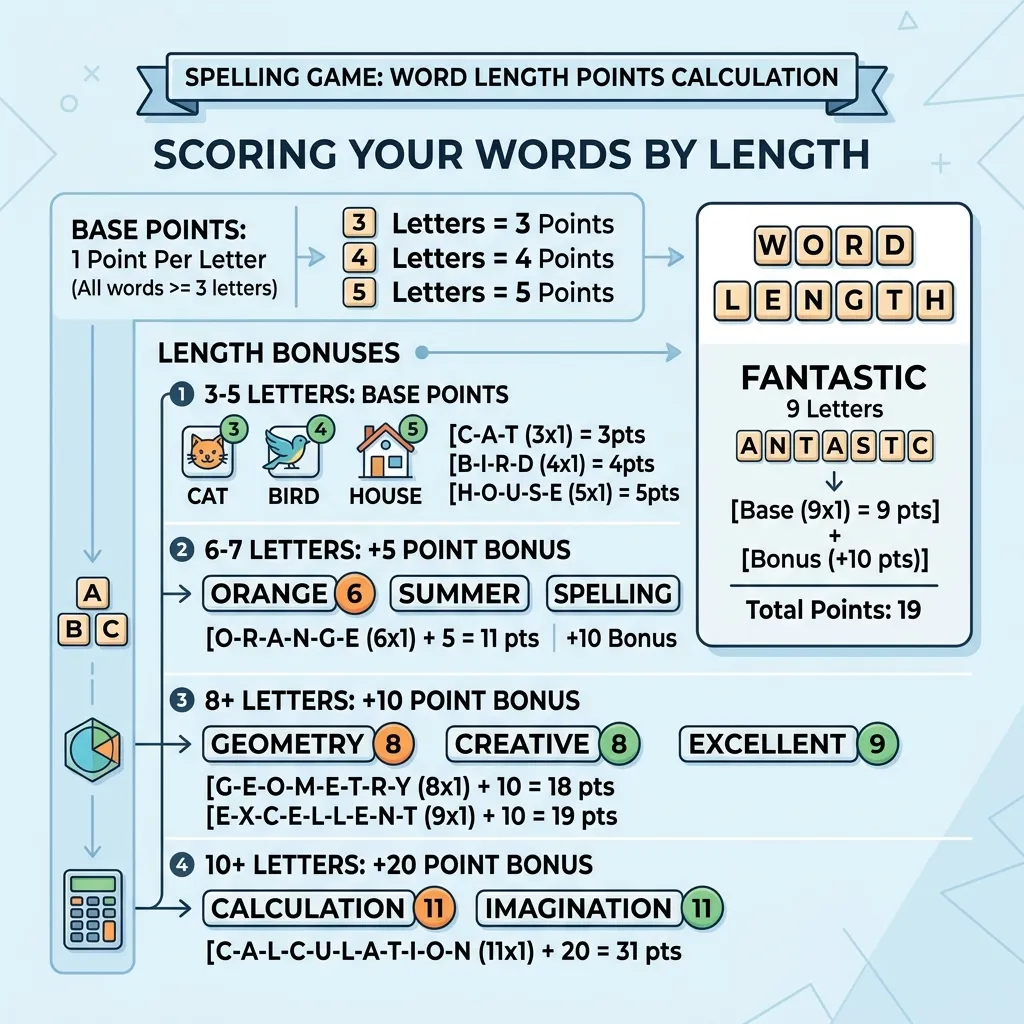
Before you can understand the Genius threshold, you need to understand the basic scoring math. Words must be at least four letters long to be accepted. A four-letter word earns you exactly 1 point. Any word longer than four letters earns points equal to its length. For example, a 5-letter word is worth 5 points, and a 7-letter word is worth 7 points.
If you find a Pangram (a word that uses every single letter in the honeycomb at least once), you receive a 7-point bonus on top of the word's length score. This makes finding the daily pangram crucial for boosting your score quickly.
The Genius Threshold
The total number of points available in a puzzle is the sum of every valid word's score. The NYT sets the "Genius" rank at approximately 70% of the total possible points for that day. This means on days with a massive word list, the Genius threshold might be over 200 points. On days with a small, restricted letter set, Genius might be achieved at just 80 points.
If you want to see exactly where you stand, you can use a Genius rank calculator to check the exact thresholds for the day's puzzle without spoiling the actual answers.
Queen Bee Status
If Genius is ~70%, what happens when you find 100% of the words? You achieve the hidden Queen Bee status. This rank isn't visible on the initial progress bar; it only appears once you have exhausted the entire dictionary for that specific honeycomb.

Tips for Reaching Genius
To consistently reach Genius, you need to master pattern recognition. Focus on common suffixes like -ING, -ED, and -TION. If you find yourself stuck at the "Amazing" rank, try using the two-letter tally system to narrow down the remaining words you need to cross the threshold.
If you're still stuck, you can always jump back to the Spelling Bee Hub homepage for more tools, hints, and daily breakdowns to help you conquer the hive!
Case Study: A High-Scoring vs Low-Scoring Day
To truly understand how the dynamic threshold works, it helps to look at historical data from past puzzles. On a day where the center letter is a highly versatile vowel like 'E' or 'A', and the surrounding letters include common consonants like 'R', 'S', 'T', and 'L', the total possible points can skyrocket past 300. On a day like this, reaching Genius might require a grueling 210 points. You will need to find dozens of long words and likely multiple pangrams just to cross the finish line.
Conversely, consider a day where the center letter is a difficult consonant like 'V' or 'Z', and the vowels are restricted to 'O' and 'U'. The total points available might only be 120. On a low-scoring day, you might hit Genius at a mere 84 points. While it sounds easier, these days are often much more frustrating because there are simply fewer valid words to find. Every single word you uncover feels like pulling teeth, making the climb to 84 points feel just as exhausting as the climb to 210.
This dynamic scaling is what keeps the game fresh and mathematically balanced, ensuring that the difficulty of achieving the top rank remains relatively consistent regardless of the specific letter set provided on any given morning.
Frequently Asked Questions About Spelling Bee Scoring
How many points is the rank below Genius?
The rank immediately below Genius is "Amazing". The Amazing rank is typically set at approximately 50% of the total possible points for the day. Hitting Amazing is a great milestone, but the jump from 50% to the 70% required for Genius often requires deploying advanced strategies.
Do you get bonus points for finding words quickly?
No, the New York Times Spelling Bee does not feature a timer or speed bonus. Whether you find all the words in ten minutes or over the course of twelve hours, your score remains exactly the same. The game is purely based on vocabulary and pattern recognition, not speed.
Is it possible to lose points?
No. You are never penalized for guessing incorrectly. If you input a word that is not in the dictionary, the game simply rejects it and you can keep trying. This encourages players to experiment with prefixes and suffixes without fear of dropping in rank.