
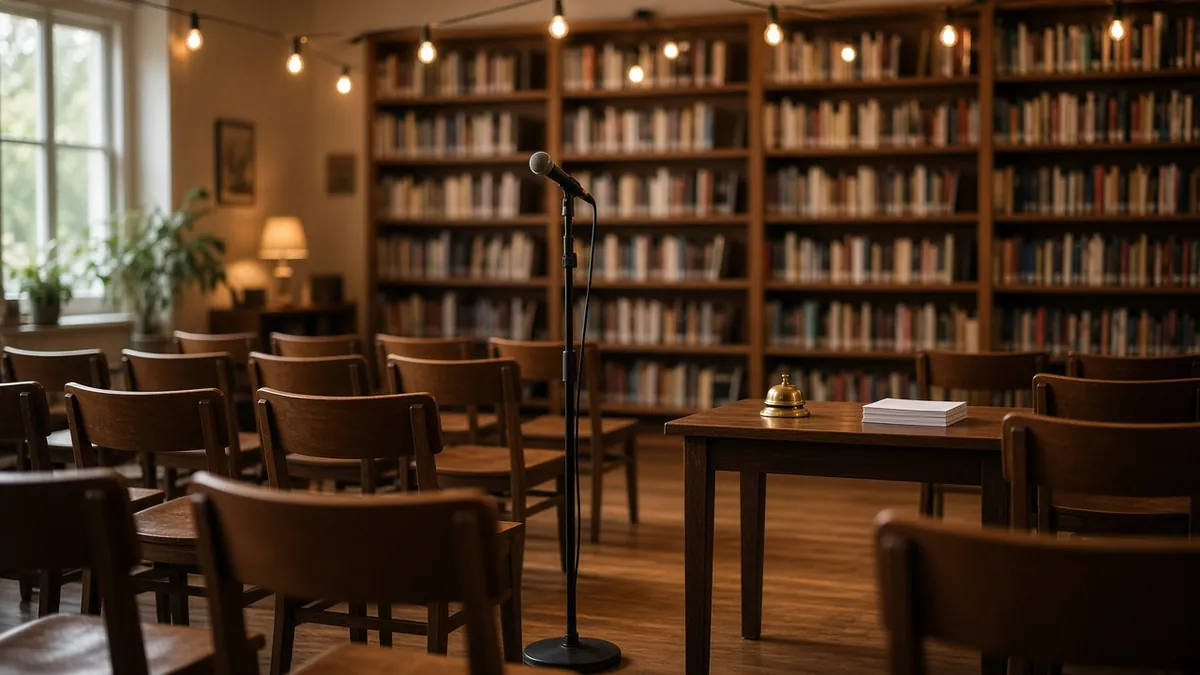
An adult spelling bee is one of the easiest group events to run: you need a word list, a microphone, a judge with a dictionary and a room full of people who think they can spell. It works as an office party game, a bar trivia night, a library program or a charity fundraiser. This guide covers formats that suit grown-ups, how to build a word list by round, fair judging rules, and simple ways to raise money if the bee is for a good cause.
If you want word ideas before you start, browse our lists of difficult spelling bee words and the most common spelling bee words. Both work well for adult rounds.
Why adult spelling bees work so well
Most adults have not stood up and spelled a word aloud since school. That mix of nerves and nostalgia is the fun. A well-run adult spelling bee is quick to understand, gives everyone a turn, and creates easy drama: the room goes quiet, someone asks for the definition, and the whole audience silently spells along.
It is also low-cost. Unlike a quiz night, you do not need dozens of researched questions, only a reliable word list and one dictionary to settle arguments. The national Scripps bee is only for students, so an adult bee is a chance for grown-ups to try the format for themselves.
Choose a format
Pick the format before you build the word list, because it decides how many words you need and how long the event runs.
| Format | Best for | How it works |
|---|---|---|
| Classic individual | Libraries, small groups | Spellers take turns; a miss means elimination |
| Team bee | Offices, fundraisers | Teams of three confer for 20–30 seconds, one person spells |
| Written rounds | Bars, big crowds | Everyone writes the word; correct answers score a point |
| Hybrid | Two-hour events | Written rounds to qualify, then a live individual final |
Team bees are the most popular choice for adults. People who would never volunteer alone will happily join a team, and conferring makes the hard words more fun. Written rounds are best when you have more than 40 people, because everyone plays every word and nobody waits too long.
Set the ground rules
Write your rules on one page and read them out before the first word. Clear rules stop arguments later.
- One official dictionary. Name it in advance. Merriam-Webster is the standard choice in the United States, and the national Scripps bee uses Merriam-Webster Unabridged.
- What spellers may ask. Allow requests for the definition, part of speech, a sentence, the language of origin and a repeat of the word.
- Time limit. Thirty seconds for individuals, sixty for teams, with a visible timer.
- No restarts that change letters. A speller may stop and restart from the beginning, but cannot change letters already said in a new order. This is the classic bee rule and is worth keeping.
- Ties. Decide in advance how a final tie is broken, such as a written sudden-death word.
Build your word list by round
Adults spell better than children, so start harder than you think and climb quickly. Plan about 25 words per round for a team bee with ten teams, plus spares.
Round 1: warm-up words
Choose words that look easy but trip people up. These build confidence and still knock out a few teams.
accommodate, separate, definitely, necessary, embarrass, rhythm, calendar, occasionally, maintenance, privilege, receive, conscience, millennium, recommend, weird.
Round 2: everyday traps
These are words adults use often but rarely write by hand.
bureaucracy, entrepreneur, liaison, questionnaire, conscientious, Fahrenheit, mischievous, pharaoh, playwright, restaurateur, supersede, threshold, vacuum, harass, guarantee.
Round 3: words from other languages
Origin questions help here, so this round rewards spellers who ask.
hors d'oeuvre, cappuccino, connoisseur, déjà vu (accept without accents), kindergarten, schadenfreude, smorgasbord, bourgeois, chauffeur, renaissance, silhouette, rendezvous, tsunami, piñata (accept pinata), fjord.
Final rounds: hard words
Use these only when a few spellers remain.
onomatopoeia, sacrilegious, chiaroscuro, minuscule, pneumonia, idiosyncrasy, bougainvillea, logorrhea, dachshund, staphylococci, vichyssoise, Cheshire, eudaemonic, cymotrichous, appoggiatura.
Our spelling bee longest word page has more giant words if your final runs long.
The roles you need
Even a small bee runs better with named roles. One person can cover two roles at a casual event.
- Pronouncer. Reads each word clearly, gives definitions and sentences. Practise the hard words in advance with the dictionary audio.
- Judge. Follows the official spelling on paper and makes every ruling. Their decision is final.
- Timekeeper. Runs the timer and calls time.
- Host. Keeps the energy up, explains rules, introduces teams and fills pauses.
- Scorekeeper. Needed for written rounds; tracks points on a whiteboard or a shared sheet.
Tips for whoever reads the words: our spelling bee pronouncer guide.
Running the night: a sample schedule
A two-hour adult spelling bee might run like this:
- Doors and team sign-up (20 minutes). Teams register, choose a name and pay any entry fee.
- Rules and practice word (10 minutes). Do one practice word so everyone hears the process.
- Round 1 (20 minutes). Warm-up words, eliminations or points.
- Break (10 minutes). Sell lifelines, raffle tickets or snacks.
- Rounds 2 and 3 (35 minutes). Harder words.
- Final (15 minutes). Last teams or individuals on stage.
- Awards (10 minutes). Trophies, thank-yous and announcements.
Keep a visible timer and a short pause between words. The pace matters more than the difficulty: a fast bee keeps the room laughing, while a slow one loses the crowd.
Fundraiser ideas
Spelling bees are a classic charity event because they are easy to sponsor. If yours is a fundraiser, try a few of these ideas:
- Team entry fee. A flat fee per team covers costs and builds the pot.
- Buy a lifeline. Teams pay to use a lifeline, such as "ask the audience" or "hear the word in a sentence twice." Limit each team to two.
- Buy back in. An eliminated team can pay once to rejoin in the next round.
- Sponsor a round. Local businesses sponsor a round and get a mention from the host.
- Costume prize. Encourage themed team outfits with a small prize.
Check your local rules on raffles and charitable gaming before selling raffle tickets, as those vary by state and venue. Keep a clear record of what you raise so donors can see where the money goes.
Office spelling bee tips
A workplace bee should be friendly, not stressful. A few adjustments help:
- Use mixed teams across departments so it doubles as a team-building activity.
- Add a themed round with words from your industry, such as legal, medical or tech vocabulary.
- Keep it short. Thirty to forty-five minutes is enough for a lunch event.
- Make losing fun. Give a prize for the best team name or the most creative wrong answer.
- Avoid embarrassing anyone. Let people opt for team play instead of solo spelling.
For remote teams, a written round on a video call works well. Read each word, give everyone thirty seconds to type it privately to the host, then reveal the answers together.
Bar and trivia-night spelling bees
Bars and restaurants that already host trivia can run a spelling bee as a themed night. Use written rounds so every table plays every word, and score one point per correct spelling. Add a bonus point for the fastest correct answer handed in. Finish with a live final between the top two tables, spelled aloud at the microphone.
Keep the word list on paper or a tablet that only the judge sees, and keep the volume of the background music low during each word.
For a looser night, mix in a few holiday word games.
Library and community bees
Libraries often host adult or family bees to support literacy programs. Mixed-age teams are popular: one adult and one older student per team makes a friendly, multigenerational event. Use our classroom spelling bee guide for the student-side rules and this page for the adult rounds.
If you want to practise with a daily word puzzle beforehand, our spelling bee help page explains how word puzzles build spelling skill. Sbeehub is an independent site and is not affiliated with The New York Times or any official bee.
Prizes that people actually want
Simple prizes work best: a trophy, a gift card, a donated dinner, or a golden bee pin. A funny trophy, such as a giant dictionary signed by all teams, often becomes the most talked-about part of the night. For fundraisers, ask local businesses to donate prizes in exchange for a mention.
Frequently Asked Questions
What is an adult spelling bee?
An adult spelling bee is a spelling contest for grown-ups, often run as a team event at an office, bar, library or charity night. Players spell words aloud or in writing, and a judge checks each answer against one official dictionary.
How many words do I need for an adult spelling bee?
For a team bee with about ten teams, plan around 25 words per round and four rounds, plus 20 spares. Written rounds need fewer words because every team spells each word at the same time.
What dictionary should an adult spelling bee use?
Pick one dictionary and announce it before the event. Merriam-Webster is the usual choice in the United States, and the official Scripps bee uses Merriam-Webster Unabridged.
How do you make a spelling bee a fundraiser?
Charge a team entry fee, sell lifelines, allow one paid buy-back, and ask local businesses to sponsor rounds or donate prizes. Check local rules before selling raffle tickets.
Can adults enter the Scripps National Spelling Bee?
No. The Scripps National Spelling Bee is for students who have not passed eighth grade. Adults can enjoy the format at community, office or charity bees instead.
What are good words for an adult spelling bee?
Start with tricky everyday words like accommodate, rhythm and liaison, then move to words from other languages such as connoisseur and rendezvous. Save very hard words like onomatopoeia and appoggiatura for the final.