
Some mornings the hive feels friendly. Words spill out effortlessly, you hit "Amazing" in six minutes, and Genius is within casual arm's reach. Other mornings you stare at seven letters for twenty agonizing minutes and still sit stuck at "Nice." If you have ever typed why is spelling bee so hard into Google after a brutal grid, you are not imagining it — daily difficulty really does swing dramatically.
This guide explains what actually causes an NYT Spelling Bee puzzle to feel so punishing, whether weekends are intentionally designed to be tougher, and how to calibrate your solving strategy without spoiling the fun. When you want an immediate live read on today's puzzle difficulty and metrics, check our dedicated Spelling Bee analysis for today.
⚡ Quick Answer: What Makes It So Hard?
Spelling Bee difficulty stems primarily from letter chemistry and the mandatory center letter, not from a rigid Monday-to-Saturday schedule like the NYT Crossword. An awkward center letter (like V, W, or J), a sparse word pool, an obscure pangram, or an uncooperative consonant mix can make Genius feel nearly impossible.
While digital puzzles editor Sam Ezersky frequently reserves longer or more challenging hives for the weekend when solvers have more free time, weekday puzzles can still be exceptionally grueling. Judge the letters in front of you, not the calendar day!
1. It Is Not (Exactly) Like the Crossword
Crossword aficionados are trained on a predictable weekly cadence: Monday is gentle, Wednesday is moderate, and Saturday is an uncompromising test of endurance. Many solvers instinctively assume the Spelling Bee adheres to this exact same difficulty ladder.
In reality, the Spelling Bee does not operate on a fixed weekly progression. A Tuesday puzzle can deliver an agonizing, low-word-count slog, while a Sunday hive might present a generous, flowing letter set with multiple easy pangrams.
What is true, however, is editorial curating: editor Sam Ezersky has noted that when he constructs or selects an especially demanding hive or one with a massive word count, he tends to schedule it for Saturday or Sunday. But because not every weekend puzzle is a monster, treating every Saturday as an automatic boss fight sets you up for cognitive fatigue.
2. The Center Letter Is the Volume Knob
Every single accepted word in the Spelling Bee must contain the golden center letter. Because of this absolute rule, the center letter functions as the master volume knob for daily puzzle difficulty.
| Center Letter Type | Typical Solve Experience | Underlying Cause |
|---|---|---|
| Common Vowels (E, A, I, O) | Fluid, rewarding word flow | Fits seamlessly into hundreds of standard English prefixes, roots, and suffixes. |
| High-Frequency Consonants (R, T, N, L) | Busy, dense hives | Forms ubiquitous stems like -ER, -ING, RE-, and -TION. |
| Restrictive Consonants (V, W, K, J, X, Z) | Sudden, punishing roadblock | Instantly filters out 80% to 90% of common English vocabulary and familiar roots. |
A hive that looks approachable at first glance can crush your momentum if the center letter is awkward. Common go-to prefixes like RE-, UN-, or OUT- may be completely invalidated if they cannot bridge into that mandatory center glyph.
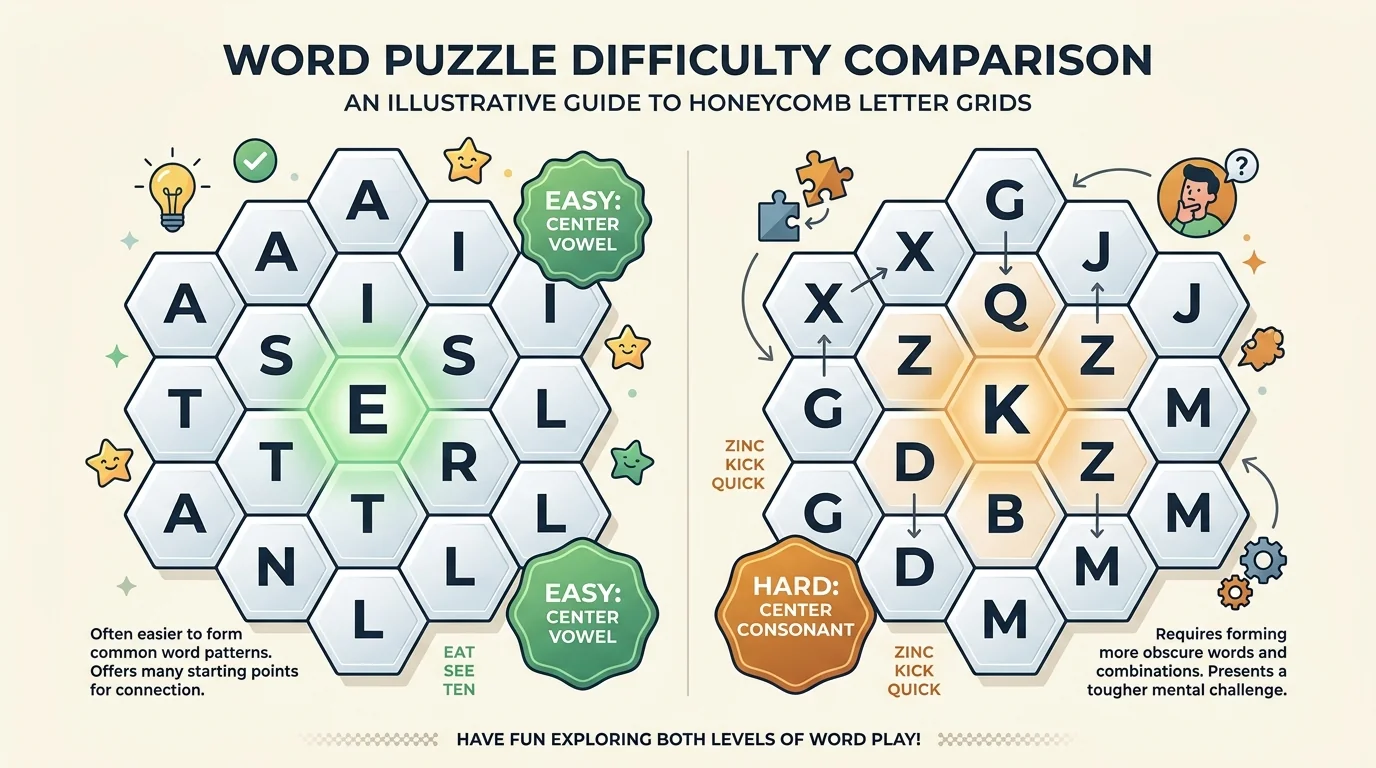
Comparing hive chemistry: High-frequency vowel centers vs restrictive consonant centers.
Practical move: Before guessing obscure words, ask yourself: "What everyday short words must contain this center letter?" Build a quick inventory of 4-letter building blocks that lock in the center letter early.
3. Word Count Changes What "Genius" Costs
To reach the coveted Genius rank, players must score approximately 70% of the total possible points in the puzzle (typically fluctuating between 68% and 72% depending on the daily threshold). That percentage dynamic produces two entirely different forms of difficulty:
- The Sparse Hive (Low Word Count): When a puzzle features only 25 to 35 total words, every single missing word carries an outsized penalty. Missing just three or four 5-letter words will completely lock you out of Genius.
- The Dense Hive (High Word Count): When a puzzle offers 60 or 70 words, there is plenty of breathing room. You can completely overlook several obscure terms and still comfortably cross the Genius finish line by sweeping standard vocabulary and snagging the pangram.
If you want to know what kind of playing field you are dealing with before committing your morning, check how many words are in Spelling Bee today for light structural guidance, or use today's hints to preview the starting-letter distribution.
4. Pangrams Can Rescue — or Gatekeep — the Day
A pangram is any word that uses all seven letters of the hive at least once. It awards a massive +7 point bonus in addition to standard word-length points. In puzzles with tight scoring margins, securing the pangram early often covers 15% to 25% of your entire journey to Genius.
On brutal days, however, the pangram acts as a formidable gatekeeper. Difficulty spikes when the pangram is:
- An obscure compound word (e.g., MEGAPHONE, NIGHTFALL)
- A technical or botanical term you rarely speak aloud
- A "perfect pangram" (exactly 7 letters with zero repeated letters) that masquerades as an innocuous, short word
When the pangram is difficult to spot, the point curve remains steep and grueling. To master the art of uncovering these high-value words, read our deep-dive on perfect pangrams explained or inspect the live pangram page.
5. Letter Chemistry Beats "Rare Letters" Alone
Solvers frequently blame unusual letters like Q, J, X, and Z. While rare letters certainly add friction, true difficulty comes down to letter chemistry — how cooperatively the vowels and consonants interact.
Consider the contrast between punishing and friendly combinations:
- Punishing Letter Chemistry: Only two vowels with awkward consonants; multiple soft consonants that rarely pair (such as W, V, and H); lack of flexible "glue" consonants (R, S, T, L, N); or a center letter that severs common morphological prefixes.
- Cooperative Letter Chemistry: Three versatile vowels (such as E, A, I); dependable consonant stems; and high-frequency letter combinations that support effortless suffix stacking like
-ING,-ED, and-ABLE.
Historical analysis shows that past hives featuring awkward chemistry leave solvers struggling regardless of their vocabulary size. You can review historical extremes in our curated hardest puzzles list and easiest puzzles list to see how letter combinations have behaved over years of archives.
6. So… Are Saturdays Really Harder?
The short answer: Often yes in practice, but by editorial convention rather than by rigid algorithm.
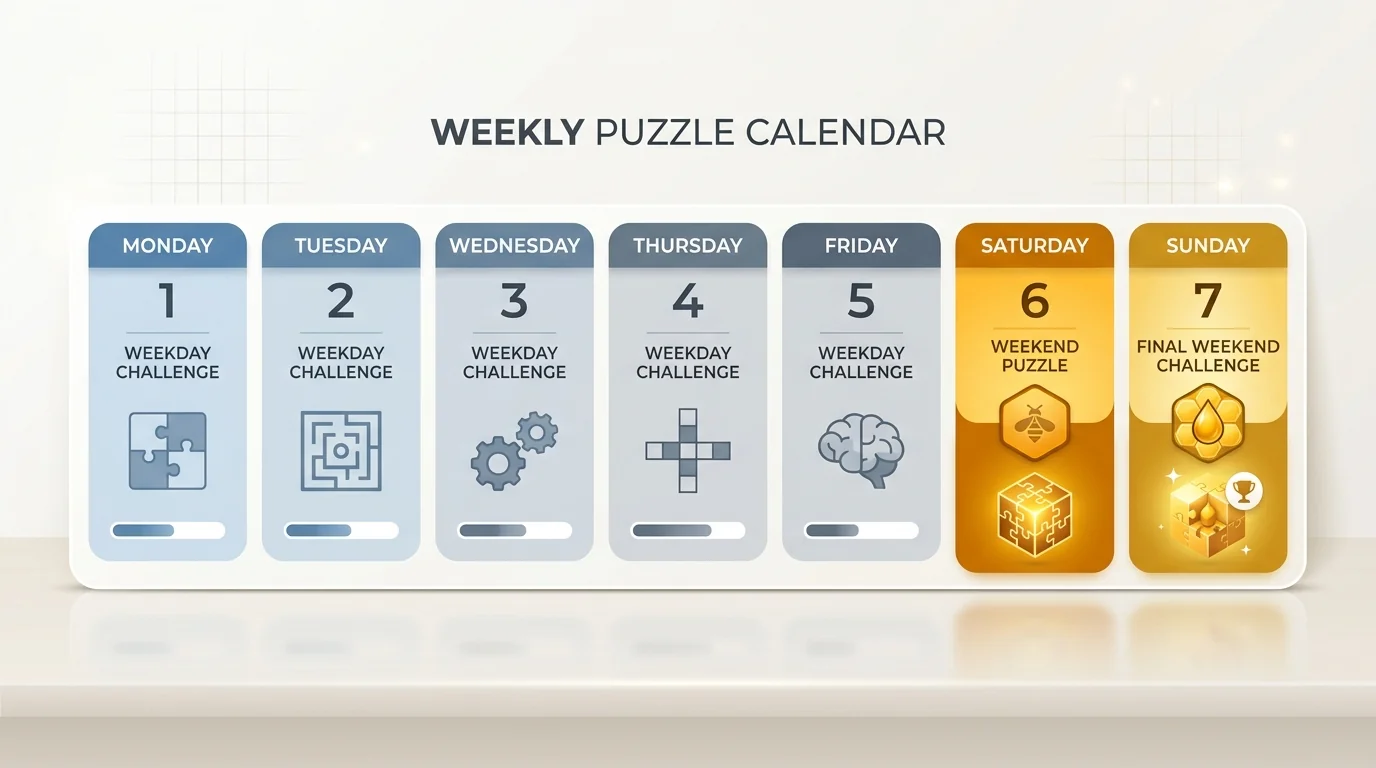
Puzzles editor Sam Ezersky often places larger, more intricate boards on Saturdays and Sundays.
Sam Ezersky knows that weekday players often solve during morning commutes or quick coffee breaks, whereas weekend solvers have leisurely mornings. Consequently, larger hives with higher point ceilings and trickier word stems are frequently slotted into Saturday and Sunday editions.
However, because there is no rigid rule enforcing this, you will regularly encounter exceptionally gentle weekend hives and savagely difficult Wednesday hives. Give yourself more time on weekend mornings, but never assume a weekday puzzle is a guaranteed cakewalk.
7. What to Do When Today Feels Impossible
When a hive feels completely impenetrable, avoid frustration by escalating through this progressive, spoiler-safe solver ladder:
- Shuffle and Step Back: Visual fixation ("hive blindness") is real. Hitting the shuffle button reorganizes your brain's spatial pattern recognition.
- Systematic Affix Sweeps: Test common prefixes (
RE-,UN-,IN-,EN-) and common suffixes (-ING,-ED,-ER,-LY,-NESS) systematically against every available letter. - Perform a Bingo Check: Can you start at least one word with every single letter in the hive? If one letter is completely blank, that's where unmined points reside. (Learn more about this term in our glossary Bingo entry).
- Consult Two-Letter Tallies: Open Spelling Bee hints to see two-letter starting tallies (e.g., "CO - 4"). This tells you exactly what to look for without spoiling the solutions.
- Calculate the Remaining Distance: Input your current tally into our Genius calculator to see how many points stand between you and your target rank.
- Full Answers (Last Resort): If you simply want to learn the missing vocabulary, consult today's answers on the homepage.
For solvers aiming beyond Genius for the elusive 100% completion mark, study our specialized manual on how to reach Queen Bee.
8. The "Bee Dictionary" Tax
One of the primary reasons the Spelling Bee feels so difficult is the idiosyncratic curation of the game's official dictionary. The NYT does not use an unabridged Scrabble dictionary. Editor Sam Ezersky manually curates the word list to balance accessibility and challenge.
This curation introduces two consistent solver frustrations:
- Common words that get rejected: Hyphenated terms, proper nouns, obscure culinary terms, and British spellings are excluded.
- Obscure words that are regularly accepted: Archaic words, niche terms (like NONET, TOMMYCOD, or AGITA), and specialized botany terms that frequent solvers have memorized over years of play.
When an obvious word gets rejected, remember: you didn't fail English; you encountered the specific boundaries of the Bee dictionary. For a breakdown of excluded categories, see our guide on why wasn't my word accepted.
9. A Simple "Difficulty Sniff Test" for Any Morning
Before concluding that you are having an off day, run through this 30-second difficulty diagnostic:
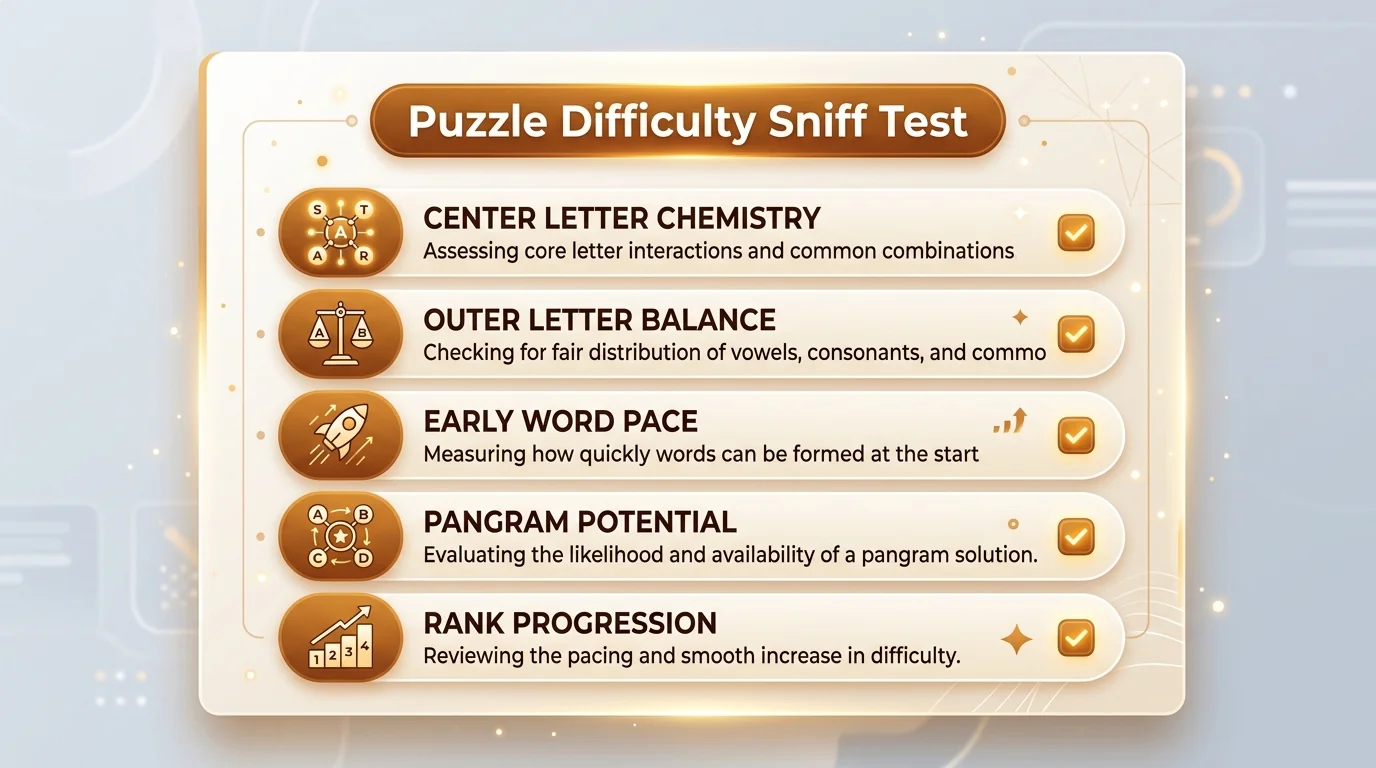
| Signal | Friendly Day Indicators | Tough Day Indicators |
|---|---|---|
| Center Letter | Common vowel (E, A, I) or versatile consonant | Rare consonant (V, W, K, J, Z) |
| Outer Letter Set | Multiple "glue" consonants (R, T, N, L) | Sparse vowels or clustering awkward consonants |
| Early Word Pace | 5+ quick 4-letter words in minute one | Painful silence after finding 2 obvious roots |
| Pangram Scent | Compound or natural word shape jumps out | No obvious vowel-consonant structure after 3 shuffles |
| Rank Progression | Smooth, steady climb through Good and Solid | Stuck at "Moving Up" despite racking your brain |
Once your sniff test confirms a tough day, modify your expectations: focus on banking short words first, accept a slower climb, and don't hesitate to consult two-letter hints earlier.
10. How Spelling Bee Hub Helps on Hard Days
Our mission at Spelling Bee Hub is to give you clarity and tools without robbing you of the joy of solving. On difficult days, take advantage of these resources:
- Today's Analysis: Real-time difficulty scores, word-length matrices, and letter distribution data.
- Daily Hints: Two-letter tallies and progressive clues that preserve the solve.
- Historical Stats: Long-term trends and puzzle difficulty benchmarks.
- Puzzle Archive: Explore past hives to sharpen your pattern recognition against tricky letter sets.
- Free Practice Game: Unlimited hives to test your word-building skills without burning today's official NYT board.
Frequently Asked Questions
Why is Spelling Bee so hard today specifically?
Because today’s center letter and outer letter set create a narrower or nastier word pool than average. Difficulty is driven by the hive design, not a sudden drop in your personal skill. Check our daily analysis for today’s exact rating.
Does the NYT Spelling Bee get harder through the week?
Not like the NYT Crossword's strict Monday-to-Saturday schedule. Spelling Bee difficulty is primarily letter-driven. While weekends often feature larger or more intricate hives by editorial choice, any weekday can present a brutal puzzle.
Is Saturday Spelling Bee always the hardest?
No. While Saturday frequently hosts longer grids with higher point ceilings, it is not a guarantee. Some Saturdays are exceptionally generous, while mid-week puzzles can be ruthless.
Does a hard center letter always mean a hard puzzle?
A restrictive center letter raises the difficulty floor because every valid submission must include it. However, if the surrounding six letters include highly cooperative vowels and consonants, the puzzle can still flow smoothly.
Is a low word count harder than a high word count?
Often yes for reaching Genius, because you must discover a substantially higher percentage of the available words. Conversely, high-word-count boards can feel harder for Queen Bee completion because of the volume of obscure words.
Should I use hints on hard days?
Absolutely. Starting with two-letter tallies and letter-length grids helps you learn recurring word patterns and affixes without spoiling the thrill of discovery.
About the Spelling Bee Hub Editorial Team
The Spelling Bee Hub Editorial Team creates daily hints, solvers, and analytical tools for word puzzle enthusiasts worldwide. We solve the hive every day and analyze historical puzzle data to explain mechanics grounded in real gameplay. Spelling Bee Hub is an independent fan publication and is not affiliated with The New York Times.