
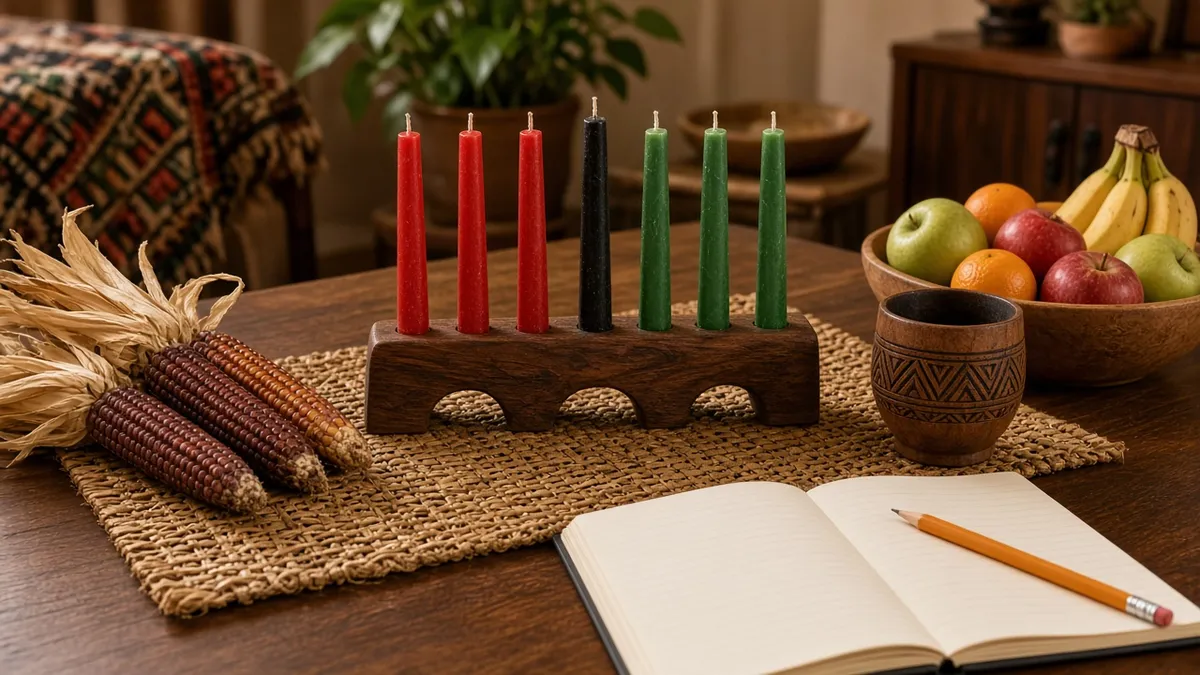
These Kwanzaa spelling words give you 50 words for a December spelling unit, grouped from kindergarten to grade 8, plus the seven principles and the main symbols in Swahili with their meanings and an easy pronunciation guide. Kwanzaa is a week-long celebration of African American culture and heritage held every year from December 26 to January 1. It was created in 1966 by Dr. Maulana Karenga, and its name comes from the Swahili phrase matunda ya kwanza, meaning "first fruits." Use the lists for weekly spelling, vocabulary lessons or a December classroom bee.
Spelling Bee Hub is an independent site and is not affiliated with The New York Times.
Kwanzaa at a glance
| Dates | December 26 to January 1 every year |
| Created | 1966, by Dr. Maulana Karenga |
| Name | from Swahili matunda ya kwanza, "first fruits" |
| Colors | black, red and green |
| Core idea | seven principles, the Nguzo Saba, one for each day |
| Feast | Karamu, on December 31 |
All facts here follow the Official Kwanzaa Website. When teaching about any cultural or religious celebration, keep the tone informational and invite students who celebrate to share only if they want to.
Kindergarten and grade 1 words
Short, decodable words tied to the celebration:
- candle
- seven
- red
- green
- black
- gift
- corn
- cup
- mat
- light
Sentence to spell: We light one candle each day.
Grades 2 and 3 words
- family
- harvest
- holiday
- unity
- culture
- heritage
- feast
- fruit
- respect
- celebrate
Sentence to spell: My family shares a feast at the end of the week.
Grades 4 and 5 words
- principle
- tradition
- community
- ancestors
- creativity
- purpose
- faith
- cooperative
- responsibility
- self-determination
Sentence to spell: Each day of Kwanzaa honors one principle.
Grades 6 to 8 words
- commemoration
- collective
- economics
- reflection
- symbolism
- libation
- generations
- affirmation
- African American
- Pan-African
Sentence to spell: The colors of the flag carry deep symbolism.
The seven principles (Nguzo Saba)
Each day of Kwanzaa focuses on one principle. These Swahili words make an excellent challenge list for older students. Pronunciations are simple English approximations.
| Day | Swahili word | Say it | Meaning |
|---|---|---|---|
| Dec 26 | Umoja | oo-MOH-jah | unity |
| Dec 27 | Kujichagulia | koo-jee-chah-goo-LEE-ah | self-determination |
| Dec 28 | Ujima | oo-JEE-mah | collective work and responsibility |
| Dec 29 | Ujamaa | oo-jah-MAH | cooperative economics |
| Dec 30 | Nia | NEE-ah | purpose |
| Dec 31 | Kuumba | koo-OOM-bah | creativity |
| Jan 1 | Imani | ee-MAH-nee | faith |
Spelling tip: Swahili is spelled almost exactly as it sounds, and every syllable ends in a vowel. Clap the syllables (ku-ji-cha-gu-li-a) and spell one syllable at a time.
The Kwanzaa symbols
| Swahili word | Say it | Meaning |
|---|---|---|
| mazao | mah-ZAH-oh | crops, the fruits of work |
| mkeka | m-KAY-kah | the mat that holds the symbols |
| kinara | kee-NAH-rah | the candle holder |
| muhindi | moo-HEEN-dee | ears of corn, for children |
| mishumaa saba | mee-shoo-MAH SAH-bah | the seven candles |
| kikombe cha umoja | kee-KOHM-bay chah oo-MOH-jah | the unity cup |
| zawadi | zah-WAH-dee | gifts |
The candles are arranged with three red on the left, one black in the center and three green on the right. The flag, bendera, in black, red and green, is a supplemental symbol often displayed alongside them.
Bonus challenge words
For strong spellers in grades 6 to 8: karamu (the feast), bendera (the flag), habari gani (the daily greeting, "what's the news?", answered with that day's principle), Swahili, Kiswahili, commemorate and reciprocity.
Meanings for the older-grade words
Knowing what a word means makes it easier to spell, especially with long words. Use these short definitions for grades 4 to 8:
| Word | Meaning |
|---|---|
| principle | a basic rule or belief that guides how you act |
| tradition | a custom passed down from one generation to the next |
| community | a group of people who live or work together |
| ancestors | the people your family came from long ago |
| cooperative | working together for a shared benefit |
| responsibility | a duty to take care of something or someone |
| self-determination | deciding for yourself and your community |
| commemoration | an event that honors and remembers something |
| collective | done by a group as a whole |
| libation | a drink poured in honor, often for ancestors |
| affirmation | a positive statement of belief |
| reciprocity | giving and receiving in return |
Spelling patterns in the list
Grouping words by pattern helps students remember them:
- -tion endings: tradition, commemoration, reflection, affirmation. Remind students that the "shun" sound at the end is almost always spelled -tion.
- -ity endings: unity, community, creativity, responsibility, reciprocity. The ending turns an adjective-like idea into a noun.
- Hyphenated compounds: self-determination and Pan-African keep their hyphens. Ask students to spell each part, then say "hyphen."
- Double letters: harvest has none, but commemoration has a double m, and cooperative and Kuumba have double vowels. Point them out before the test.
- Capital letters: African American, Pan-African, Kwanzaa and Swahili are proper nouns, so they always start with a capital letter.
Teaching Kwanzaa respectfully
Kwanzaa is a cultural celebration, and many students may have family experience with it while others are learning about it for the first time. A few simple habits keep lessons accurate and welcoming:
- Use reliable sources, such as the official Kwanzaa website, rather than craft blogs, for facts and meanings.
- Present it as one of several December celebrations rather than a costume or a theme party.
- Let students who celebrate share if they wish, but never put anyone on the spot to explain their family's traditions.
- Focus on the principles, which connect naturally to classroom values like unity, purpose and creativity.
- Check pronunciations before saying the Swahili words aloud, and practice them together.
Test format you can copy
For a quick weekly test, read each word, use it in a sentence, then repeat it. For example: "Unity. Our class showed unity when we cleaned up together. Unity." Give younger students 10 words and older students 15 to 20, including two or three Swahili challenge words as optional bonus points.
Five ways to practice the list
- Principle of the day. Introduce one Nguzo Saba word per day with its meaning and a sentence. Spell it on the board in syllables.
- Candle chart. Draw a kinara with seven candles. Each time a student spells a word correctly, color a candle red, black or green in the correct order.
- Word sort. Sort the English words into "people," "things" and "ideas."
- Write a sentence. Older students pick three words and write a short paragraph that uses them correctly.
- Mini bee. Run a short class bee with the grade list. Our guide to running a classroom spelling bee has the rules and a script.
Word puzzles from the list
Turn the list into quick puzzles that students can finish as warm-ups or early-finisher work:
- Scrambles: write each word with its letters mixed up (YTUNI for unity, LANECD for candle) and have students unscramble it.
- Missing vowels: show K_N_R_ or M_K_K_ and let students fill in the Swahili vowels.
- Word ladder: start with "cup" and change one letter at a time to reach other short words.
- Build-a-word: give the seven letters in TRADITION and ask how many smaller words students can make, a classroom version of the letter-building puzzles our readers love. Our make your own spelling bee puzzle guide shows how to design one.
- Crossword clues: use the meanings table above as clues and the words as answers.
Practice at home
Families can practice in a few minutes a day: spell one word aloud at dinner, write the day's principle on a sticky note on the fridge, or let a child quiz a parent on the Swahili words. Short, daily practice works better than one long session the night before a test.
A one-week plan
| Day | Activity |
|---|---|
| Monday | Pre-test, introduce the list and Kwanzaa facts |
| Tuesday | Syllable clapping and the principle words |
| Wednesday | Word sort and sentence writing |
| Thursday | Partner quiz and candle chart |
| Friday | Final test or mini bee |
More December word lists
Build a whole December unit with our other seasonal lists: Hanukkah spelling words, Christmas spelling words, winter spelling words and New Year's spelling words. For family gatherings, try our holiday word games, and for grade-level practice all year, see the 2026 spelling words by grade.
Frequently Asked Questions
What are good Kwanzaa spelling words for kids?
For young children, try candle, seven, gift, corn, cup, red, green and black. Grades 2 and 3 can add family, harvest, unity and heritage. Older students can learn principle, community, creativity and the Swahili principle names.
What are the seven principles of Kwanzaa?
The Nguzo Saba are Umoja (unity), Kujichagulia (self-determination), Ujima (collective work and responsibility), Ujamaa (cooperative economics), Nia (purpose), Kuumba (creativity) and Imani (faith). One is honored on each of the seven days.
When is Kwanzaa in 2026?
Kwanzaa runs from Saturday, December 26, 2026 to Friday, January 1, 2027. The dates are the same every year.
How do you pronounce Kujichagulia?
Say koo-jee-chah-goo-LEE-ah. Swahili is spelled as it sounds, so clapping the syllables (ku-ji-cha-gu-li-a) helps students spell it correctly.
What does the word Kwanzaa mean?
Kwanzaa comes from the Swahili phrase matunda ya kwanza, which means "first fruits." It reflects the harvest celebrations that inspired the holiday.
What are the colors of Kwanzaa?
Black, red and green. On the kinara, the black candle sits in the center with three red candles on the left and three green candles on the right.